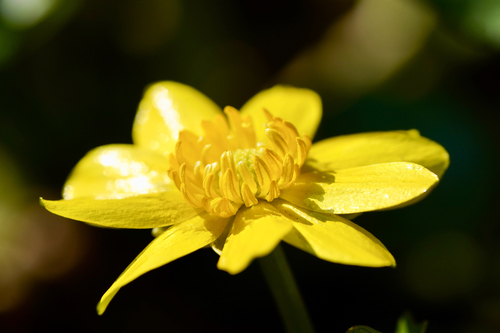
Ficaria, Genus, spp., Multiple species,
- Genus
- Multiple species
lesser celandine
Europe, western Asia, and North Africa
Overview
Ficaria is a small genus in the buttercup family (Ranunculaceae) made up of low-growing, spring-flowering perennials native to Europe, western Asia, and North Africa. The genus is represented mainly by Ficaria verna (lesser celandine, formerly placed in Ranunculus), and recent treatments recognize several subspecies that differ in chromosome number, bulbil production, and habit. Plants form a low rosette 2-12 inches (5-30 cm) tall of glossy, dark green, heart-shaped to kidney-shaped leaves on long stalks, rising from clusters of small finger-like root tubers. In early spring they produce solitary, star-shaped flowers 0.8-1.2 inches (2-3 cm) across with 7-12 glossy yellow petals that fade to white with age. Many forms also make tiny pale bulbils in the leaf axils that detach and grow into new plants. Ficaria is a spring ephemeral: foliage and flowers appear in late winter to spring, then the whole plant dies back to the tubers by early summer and stays dormant until the following year. The tubers and bulbils spread readily, and several subspecies have become invasive in parts of North America, where F. verna is listed as a noxious weed in a number of states. Fresh foliage contains protoanemonin and is irritating if eaten.
Native Range
Ficaria is native to Europe, western Asia, and North Africa, growing in damp woodland, hedge banks, stream sides, and meadows. F. verna has been introduced to North America, where several subspecies have naturalized and spread aggressively in moist woodlands and floodplains.Suggested Uses
Ficaria is sometimes grown as a spring-flowering groundcover in damp, shaded gardens and naturalistic woodland plantings, with double-flowered and bronze-leaved cultivars chosen for their restraint. Because the wild forms spread quickly, the genus is more often encountered as a naturalized plant of moist ground than as a deliberate planting in regions where it is invasive.How to Identify
Appearance
Size & Dimensions
Height2" - 1'
Width/Spread6" - 1'6"
Bloom Information
Flowering runs from late winter into mid-spring, roughly February to May depending on climate, often before deciduous trees leaf out. Each flower opens in sunshine and closes in dull weather or at night. The early bloom supplies pollen and nectar to bees and hoverflies at a time when few other flowers are open.
Detailed Descriptions
Foliage Description
dark greenGrowing Conditions
Sun Requirements
Requires 3-8 hours of direct sunlight daily
• Full Sun: 6+ hours of direct sunlight
• Partial Shade: 3-6 hours of direct sunlight
• Full Shade: Less than 3 hours of direct sunlight
Care & Maintenance
Care Guide
Ficaria grows in part shade to full sun and prefers moist, humus-rich soil that stays damp through spring. It tolerates seasonal flooding and heavy clay, and goes dormant as soils dry in summer. Plants spread by both tubers and bulbils, so even small fragments left in the soil can regrow. In garden settings the wild form can colonize lawns and beds quickly, while named cultivars are generally less aggressive. Growth needs no feeding or watering once established, as the plant completes its cycle during the moist spring months.Pruning
No pruning is needed for this low ephemeral. Removing flower heads before bulbils and seed form helps limit spread, though tubers below ground will still return. Foliage is left to die back naturally, as it replenishes the tubers for the following season.Container Growing
Suitable for container growing
Minimum container size: 1 gallons
