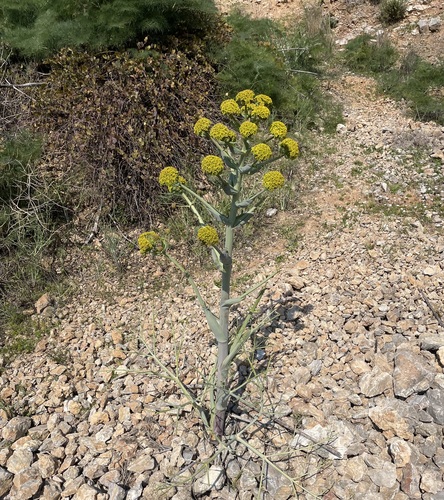
Ferula, Genus, communis, Species,
- Genus & species
giant fennel
Mediterranean region across southern Europe (Italy, Greece, Spain, Turkey), North Africa, and western Asia; rocky hillsides, disturbed ground, and open scrubland at low elevations
Overview
Ferula communis is a tall upright deciduous perennial in the family Apiaceae reaching 5–13 feet (1.5–4 m) tall in bloom and 3–5 feet (0.9–1.5 m) wide from a woody tuberous root crown. Leaves are pinnately compound and very finely dissected into thread-like segments, 12–24 inches (30–60 cm) across and the same in height, forming a feathery bright green foliage mound at ground level; the Mediterranean growth cycle of the species emerges new foliage from the dormant root crown in fall, carries the foliage mound through winter and spring, and sends up the tall flowering stem in May before the entire above-ground plant dies back to the tuberous root during the summer dry period. Yellow tiny flowers are carried in large flat-topped compound umbels 6–12 inches (15–30 cm) across at the top of tall thick hollow flowering stems from May through June across a 3-week bloom period, and the umbels are worked heavily by honeybees, native bees, hoverflies, and butterflies during the late-spring nectar window. The species is not edible fennel: culinary fennel is a separate species (Foeniculum vulgare) in a different genus with an anise scent, smaller size, and a distinct bulb. The dried hollow flowering stems were used in classical antiquity for transporting fire embers over long distances because the pithy interior smolders slowly without igniting the outer stem, and the Greek myth of Prometheus stealing fire from Mount Olympus describes the fire as carried down in a hollow Ferula stem. Limitation: the species is often monocarpic — some plants flower once and die after setting seed at the end of the second or third flowering season, and the behavior is not reliably predictable from seed stock, which makes replacement a recurring consideration in the planting. Seed-to-first-bloom takes 3–5 years because the species builds the root crown mass across several winter growing seasons before the first flowering stem emerges, and a new planting does not produce a display during the first 2–3 years. All parts of the plant contain coumarins that are toxic to livestock and humans if ingested, and grazing animals have died from consuming the foliage during the spring growing period. The species is deer-resistant because of the coumarin content, and drought-tolerant during the summer dormancy period because the tuberous root holds water reserves below the soil surface.
Native Range
Native to the Mediterranean region across southern Europe (Italy, Greece, Spain, the Balkans, Turkey), North Africa, and western Asia. Grows on rocky hillsides, in disturbed ground, and in open scrubland at low to middle elevations on well-drained calcareous or sandy substrates. The species has been cultivated in European gardens since the 17th century and is used in cut-flower production for the towering flowering stems in early summer arrangements across southern European horticulture.Suggested Uses
Used as a specimen perennial in Mediterranean-style gardens, dry borders, gravel beds, and hillside plantings at 3–5 foot (0.9–1.5 m) spacing where the feathery winter-active foliage mound and the towering 5–13 foot (1.5–4 m) flowering stems in May and June contribute seasonal drama. The tall flowering stems are also used in cut-flower arrangements during the early summer window. Small gardens, heavy clay positions, and waterlogged sites are unsuitable because of the mature size, the summer-dormant growth cycle, and the tuber-rot sensitivity to wet summer soils. Gardens with livestock access are unsuitable because of the coumarin toxicity to grazing animals.How to Identify
Appearance
Size & Dimensions
Height5' - 13'
Width/Spread3' - 5'
Bloom Information
Yellow tiny flowers are carried in large flat-topped compound umbels 6–12 inches (15–30 cm) across at the top of tall thick hollow flowering stems from May through June across a 3-week bloom period. Each stem bears a single large terminal umbel with several smaller lateral umbels below it, and the umbels are worked heavily by honeybees, native bees, hoverflies, and butterflies during the late-spring nectar window. Seed sets through July and August and matures in August and September as the flowering stem dries and turns tan-brown.
Detailed Descriptions
Flower Description
yellow tiny flowers carried in large flat-topped compound umbels 6-12 inches (15-30 cm) across at the top of tall thick hollow flowering stems from May through JuneFoliage Description
bright green; pinnately compound and very finely dissected into thread-like segments, 12-24 inches (30-60 cm) across and the same height, forming a feathery foliage mound; emerges from the tuberous root crown in fall, persists through winter and spring, then dies back during summer dormancy on the Mediterranean growth cycleGrowing Conditions
Sun Requirements
Requires 6-10 hours of direct sunlight daily
• Full Sun: 6+ hours of direct sunlight
• Partial Shade: 3-6 hours of direct sunlight
• Full Shade: Less than 3 hours of direct sunlight
Care & Maintenance
Care Guide
Site in full sun with 6 or more hours of direct sun per day in well-drained soil with a pH of 6.0–8.0; the species tolerates alkaline substrates including chalk and limestone as well as sandy soils and is not successful on heavy clay or waterlogged positions because the tuberous root rots during summer dormancy in wet soils. Planting is from seed sown in fall because the tuberous root taproot makes transplant difficult at any size, and a new planting calls for 3–5 years of root development before the first flowering stem emerges. The Mediterranean growth cycle produces active foliage during the fall-through-spring wet season and complete above-ground die-back through the summer dry period, so supplemental irrigation is applied only during the spring growing period when needed and the plant receives no water between June and September once established. The species is often monocarpic and a flowered plant may die after setting seed at the end of the second or third flowering season, which calls for staggered seed sowings to maintain a planting across several years. All parts of the plant contain coumarins and are toxic to livestock and humans if ingested. Hardy in USDA zones 7–10.Pruning
The spent flowering stem can be left standing for winter structure through August, September, and into the following winter as the hollow tan stem carries an architectural silhouette after the summer die-back, or the stem can be cut to the ground in late summer (August or September) after the seed has matured and dispersed. Dead foliage from the winter growing period is removed as it withers in late spring and early summer when the plant enters summer dormancy. Seed can be collected from the ripe umbels for fall sowing where the species is to be propagated. No other pruning is needed.Pruning Schedule
Prune: August–September
summer