Exocarpos, Genus, latifolius, Species,
- Genus & species
broad leaved native cherry
Northern and eastern Australia, Southeast Asia, Pacific
Overview
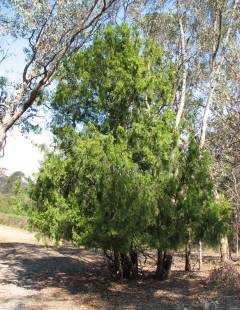
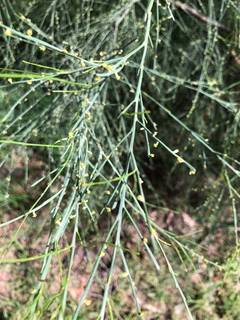
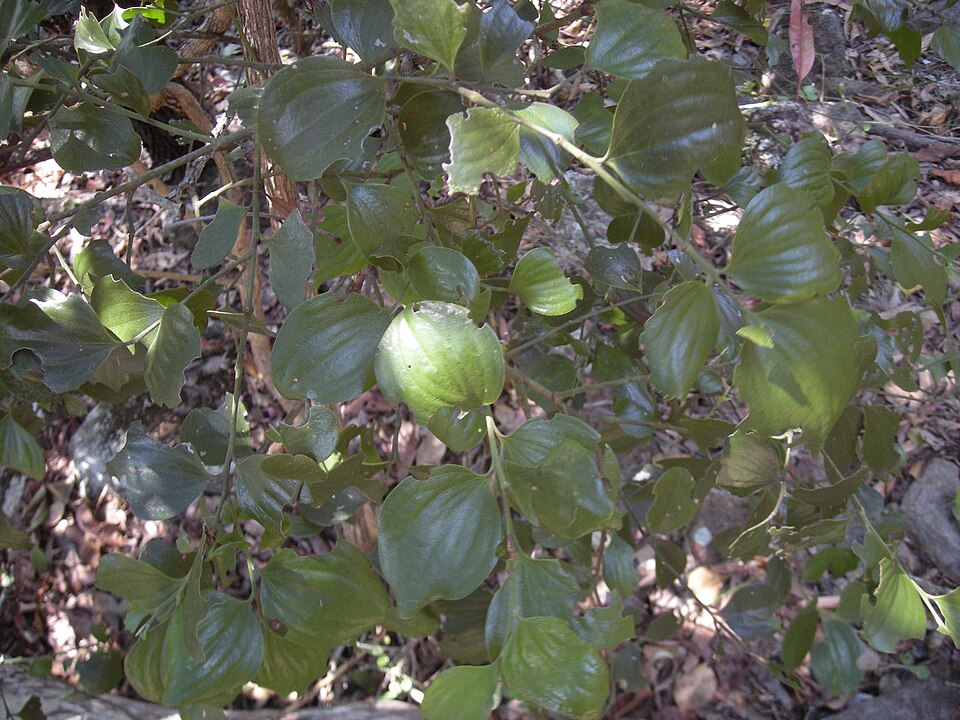
Exocarpos latifolius is an evergreen shrub or small tree reaching 10-25 feet (3-8 m) tall, with a spreading, often drooping crown. Unlike most of its relatives it has broad leaves, oval to elliptic, 1-3 inches (2.5-8 cm) long, leathery and dull green. The species is a root hemiparasite, drawing water and nutrients from the roots of nearby host plants while still photosynthesizing through its own leaves. Tiny greenish flowers along the small branches are followed by a hard green-to-black seed about 0.2 inch (5-8 mm) long that sits on top of a swollen, fleshy red stalk. The fleshy red stalk is the edible part, sweet when fully ripe. Flowering and fruiting occur over much of the year, mainly in the warmer months. Because it needs a living host, the species is hard to establish in cultivation from seed alone.
Native Range
Native to northern and eastern Australia, from the Kimberley across the tropical north to Queensland and coastal New South Wales, and through parts of Southeast Asia and the Pacific. Grows in open forest, woodland, and monsoon vine thickets on a range of soils.Suggested Uses
Grown in native and bush-food gardens in warm regions, spaced 8-15 feet (2.4-4.5 m) apart near compatible host plants. The ripe red fruit stalks are eaten fresh and draw native birds. The need for a host root makes it harder to establish than non-parasitic shrubs.How to Identify
Appearance
Size & Dimensions
Height10' - 25'
Width/Spread8' - 20'
Bloom Information
Detailed Descriptions
Foliage Description
dull greenGrowing Conditions
Sun Requirements
Requires 5-10 hours of direct sunlight daily
• Full Sun: 6+ hours of direct sunlight
• Partial Shade: 3-6 hours of direct sunlight
• Full Shade: Less than 3 hours of direct sunlight
Care & Maintenance
Care Guide
Grows in full sun to light shade on free-draining soils in warm climates. As a root hemiparasite it establishes most reliably where suitable host plants are present, whose roots it taps for water and nutrients. Water through establishment; mature plants tolerate seasonal drought. It is hard to raise from seed alone because young plants need to connect to a host root. Frost damages growth in cold sites.Pruning
Tolerates light pruning to shape the crown. Lower branches can be removed to expose a short trunk. Cutting out damaged wood after the main fruiting period keeps the crown open.Pruning Schedule
Prune: April–May
fall