Image 1 of 6
1 / 6
Plant Reference
Erysimum, Genus,
- Genus
wallflower
Europe, Asia, and North America — over 150 species distributed across rocky slopes, old walls, cliffs, garrigue, and disturbed ground; particular diversity in the Mediterranean basin, southwest Asia, and western North America
Overview
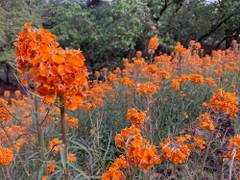
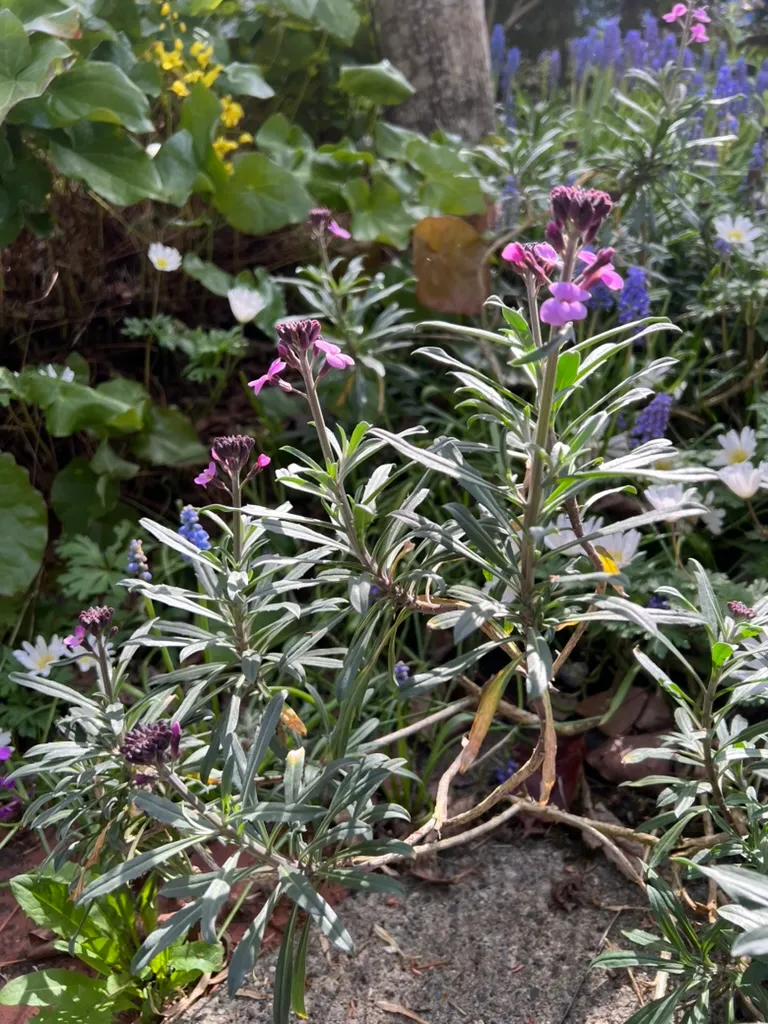
Erysimum spp. is a genus of roughly 150 upright evergreen to deciduous perennial, biennial, and annual plants in the family Brassicaceae, with cultivated garden species growing 6-36 inches (15-90 cm) tall and 12-24 inches (30-60 cm) wide. The perennial species carry narrow lance-shaped gray-green to silvery-green evergreen leaves 1-4 inches (2.5-10 cm) long covered with stellate (star-shaped) surface hairs that give the foliage its characteristic silvery tone, and upright stems terminate in dense racemes of 4-petaled cruciform flowers 0.5-0.75 inch (1.3-2 cm) across during late winter and spring — the 4-petaled cruciform flower shape is the family character for Brassicaceae across all genera. Flower colors span yellow, orange, red, pink, purple, and cream depending on species and cultivar. The flowers are moderately fragrant with a sweet spicy scent that carries from the planting on warm days, and the scent is one of the main reasons the species is grown in sunny positions near paths, doorways, and seating areas where the fragrance reaches people during the long February-through-June bloom window. The main cultivation limitation of the perennial wallflowers is a short lifespan: most cultivated perennial species decline after 2-4 growing seasons and need replacing through cuttings or seed, and a planting that is left in place without periodic replacement gradually thins out and loses its display. The 'Bowles's Mauve' cultivar (a long-blooming 30-inch / 75 cm purple-flowered clone introduced by Edward Augustus Bowles) is the named cultivar most frequently offered in the garden trade as a long-season border perennial, and E. cheiri (the English wallflower) is the biennial species grown for spring bedding displays in European traditional gardens. Sharp drainage is required across the genus — crown rot develops in wet winter soils and is the typical cause of plant loss in heavy clay or poorly drained sites. The species does not tolerate humid summer conditions well and develops fungal leaf diseases in the southeastern United States and similar hot-humid climates. Plants contain cardiac glycosides concentrated in the foliage and seeds and are toxic to humans, dogs, cats, and livestock if ingested in quantity — the glycosides cause cardiac arrhythmia and vomiting in the same class of effects as the cardiac glycosides of Digitalis and Convallaria. Deer avoid the foliage because of the glycoside content. Erysimum is drought-tolerant once established and is a standard component of Mediterranean-climate and dry-border plantings.
Native Range
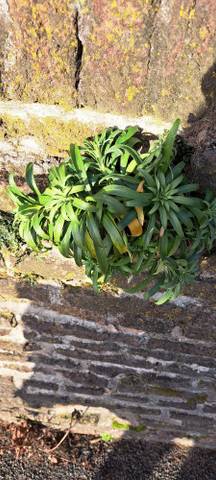
Erysimum is a large Northern Hemisphere genus with over 150 species distributed across Europe, temperate Asia, and North America. Centers of diversity include the Mediterranean basin (where several cultivated species originate), southwest and central Asia, and western North America (where numerous native species grow on serpentine outcrops, chaparral slopes, and coastal bluffs). The genus grows on rocky slopes, old walls, cliffs, garrigue, chaparral, and disturbed ground across its range, and the common name 'wallflower' comes from the habit of European species colonizing the mortar joints of old stone walls where sharp drainage and alkaline lime content match the plants' native habitat requirements.Suggested Uses
Planted in Mediterranean-climate borders, rock gardens, gravel gardens, dry mixed borders, coastal gardens, chalky limestone gardens, old stone wall joints and raised beds, and containers of 2 gallons (7.5 L) or larger at 12-24 inch (30-60 cm) spacing in zones 6-10. The long February-to-June bloom window, the sweet spicy fragrance, and the drought tolerance once established give the genus a role as a dry-border spring and early-summer bloomer in sunny positions where the fragrance can reach people near paths, doorways, and seating areas. The 'Bowles's Mauve' cultivar is grown as a long-blooming border perennial for mixed Mediterranean plantings, and the biennial E. cheiri (English wallflower) is grown for spring bedding displays in European traditional gardens where the plants are replaced each year as part of a formal bedding rotation. Not suited to wet winter soils where crown rot is unavoidable, humid summer climates where fungal leaf diseases become recurring, shady positions where flowering is weak, heavy clay sites without drainage improvements, or households with pets that investigate garden plants because of the cardiac-glycoside toxicity of the foliage and seeds.How to Identify
Appearance
Size & Dimensions
Height6" - 3'
Width/Spread1' - 2'
Colors
Bloom Information
Small fragrant 4-petaled cruciform flowers 0.5-0.75 inch (1.3-2 cm) across open in dense terminal racemes 2-6 inches (5-15 cm) tall from February through June in zones 6-10, lasting up to 12 weeks in favorable climates with the long bloom window representing the main ornamental value of the genus. Flower colors range across yellow, orange, red, pink, purple, and cream depending on species and cultivar. Flowers are bee- and butterfly-visited and carry a moderate sweet spicy fragrance that attracts pollinators and people alike. Deadheading spent racemes during bloom extends flowering, and cutting plants back by one-third after the main flush fades in June or July produces a secondary late-summer bloom on compact regrowth in some cultivars.
Detailed Descriptions
Flower Description
yellow, orange, red, pink, purple, or cream depending on species and cultivar; 4-petaled cruciform flowers 0.5-0.75 inch (1.3-2 cm) across in dense terminal racemes 2-6 inches (5-15 cm) tall; moderately fragrant with a sweet spicy scent that carries from the planting on warm daysFoliage Description
gray-green to silvery-green; narrow lance-shaped evergreen leaves 1-4 inches (2.5-10 cm) long with stellate (star-shaped) surface hairs that give the foliage its silvery appearance; evergreen year-round in zones 6-10Growing Conditions
Sun Requirements
Requires 6-12 hours of direct sunlight daily
• Full Sun: 6+ hours of direct sunlight
• Partial Shade: 3-6 hours of direct sunlight
• Full Shade: Less than 3 hours of direct sunlight
Care & Maintenance
Care Guide
Plant in well-drained to sandy soil with a pH of 6.0-7.5 in full sun (6+ hours); tolerated soil types include loam, sand, chalk, and rocky substrates. Sharp drainage is required across the genus — crown rot develops in wet winter soils and is the typical cause of plant loss, and positions in heavy clay or poorly drained sites are unsuitable without raising the planting area or adding substantial grit and compost to the soil. The species is drought-tolerant once established and thrives on dry chalk, limestone, and sandy soils where many other flowering perennials struggle. Plants contain cardiac glycosides concentrated in the foliage and seeds and are toxic to humans, dogs, cats, and livestock if ingested in quantity — the glycosides cause cardiac arrhythmia and vomiting in the same class of effects as the cardiac glycosides of Digitalis and Convallaria. The perennial wallflowers are short-lived — most cultivated species decline after 2-4 growing seasons, and a planting that is left in place without periodic replacement gradually thins out. Stem cuttings taken in summer root reliably and are the standard method for producing replacement plants from a named cultivar. Cut plants back by one-third after the main June flush fades to promote compact regrowth and a possible secondary bloom. The species does not tolerate humid summer conditions well and develops fungal leaf diseases in hot-humid climates such as the southeastern United States. Deer avoid the foliage because of the glycoside content.Pruning
Deadhead spent flower racemes during the long February-to-June bloom window to keep plants flowering through the season. Cut plants back by one-third after the main bloom flush fades in late June or early July — this produces compact regrowth and can trigger a secondary late-summer bloom in some cultivars. Take stem cuttings in midsummer (July-August) as insurance against plant decline, because the perennial wallflowers are short-lived and most cultivated species need replacement within 2-4 growing seasons. Rooted summer cuttings overwinter in a cold frame and are planted out the following spring to replace parent plants that have thinned out or died.Pruning Schedule
Prune: June–July
summer
Container Growing
Suitable for container growing
Minimum container size: 2 gallons