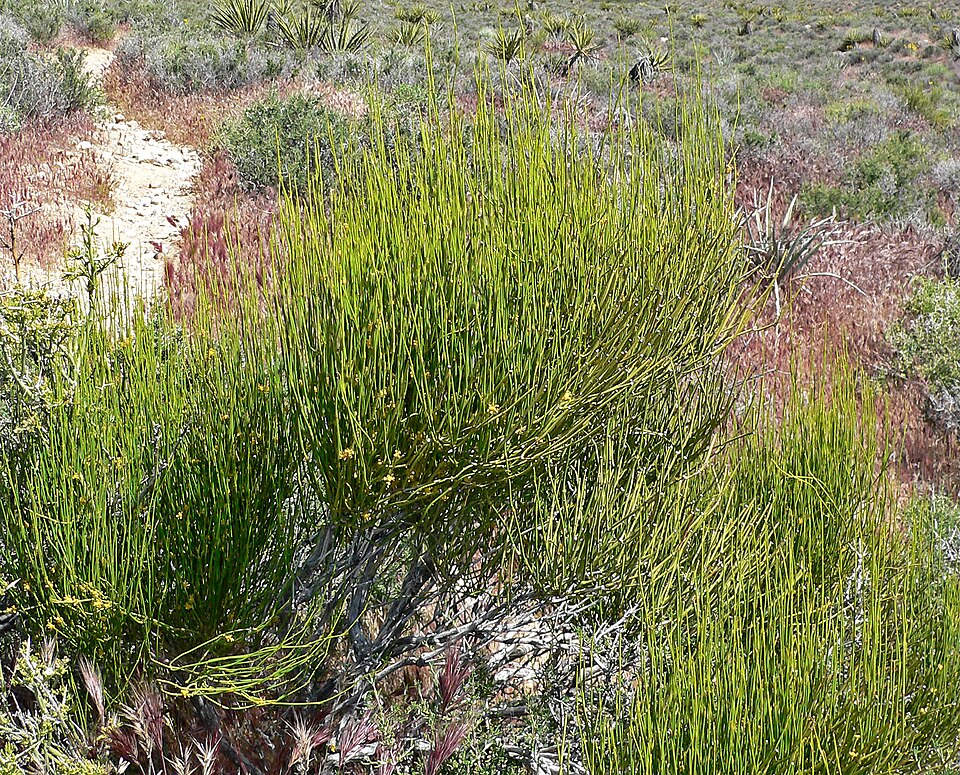
Ephedra, Genus, spp., Multiple species,
- Genus
- Multiple species
Jointfirs
Arid and semi-arid regions worldwide — the Americas, the Mediterranean, North Africa, and central Asia
Overview
Ephedra is a genus of about 50 species of gymnosperm shrubs in the family Ephedraceae, the jointfirs, native to dry and semi-dry regions across the world. Despite their broom-like, rush-like look, the plants are not flowering plants but seed plants closely related to conifers. They form upright to spreading, much-branched shrubs 1 to 6 ft (30 to 180 cm) tall, built of slender, jointed, green photosynthetic stems with the leaves reduced to small scales at each node. Most species are dioecious, with pollen cones and seed cones on separate plants; the seed cones of many species ripen into small red or brown berry-like structures. Several Asian species, including E. sinica, contain the stimulant alkaloids ephedrine and pseudoephedrine, long used in herbal medicine as ma huang and now strictly regulated, while American species such as E. nevadensis, brewed as Mormon tea, contain little or none. The genus grows on deserts, dry slopes, and sandy or rocky ground, tolerating extreme drought, heat, and poor soil. The ephedrine-bearing species are toxic to people and animals in quantity.
Native Range
Ephedra grows wild in arid and semi-arid regions worldwide, including the deserts and dry mountains of western North America, South America, the Mediterranean, North Africa, and central and eastern Asia. Several species are native to the southwestern United States and Mexico.Suggested Uses
Ephedra is grown in desert, dry, gravel, and rock gardens and in water-wise landscapes for its jointed green stems and red seed cones. It is used for erosion control and revegetation on dry, sandy, and disturbed slopes, spaced 3 to 5 ft (90 to 150 cm) apart. American species are grown in native and habitat plantings across the arid West.How to Identify
Appearance
Size & Dimensions
Height1' - 6'
Width/Spread2' - 6'
Bloom Information
As a gymnosperm, Ephedra bears cones rather than flowers, mostly in spring. Male plants release yellow pollen from small cones, and female plants carry seed cones that ripen over summer, in many species into a small red or brown fleshy structure around the seed. Pollination is by wind and, in some species, by insects drawn to sugary droplets on the cones.
Detailed Descriptions
Flower Description
no true flowers; yellow pollen cones and red or brown seed conesFoliage Description
green stems; leaves reduced to scalesGrowing Conditions
Sun Requirements
Requires 6-10 hours of direct sunlight daily
• Full Sun: 6+ hours of direct sunlight
• Partial Shade: 3-6 hours of direct sunlight
• Full Shade: Less than 3 hours of direct sunlight
Care & Maintenance
Care Guide
Ephedra grows in full sun on dry, sharply drained, sandy or rocky soil at a pH of about 6.5 to 8.5, and tolerates drought, heat, wind, and poor fertility once established. Wet, heavy, or rich soil rots the roots, so sharp drainage is the main need. Most species need little or no irrigation after the first season and no feeding. Hardiness varies by species, with many surviving to USDA zone 5, while desert species are less cold-tolerant. Plants are slow to establish and do not transplant well once their deep root systems are settled. Few pests affect the genus, and disease is rare except in poorly drained ground.Pruning
Ephedra needs little pruning. Dead or damaged stems can be removed at the base in spring, and overlong stems cut back to a joint to shape the shrub. The plants resprout from the base after hard cutting or grazing.Pruning Schedule
Prune: March–April
early spring
