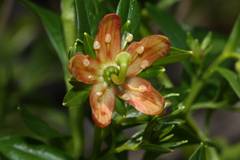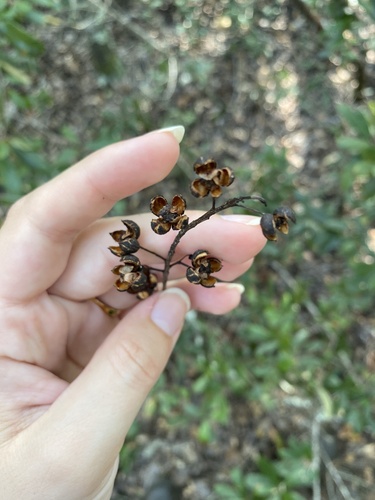
Elliottia, Genus, spp., Multiple species,
- Genus
- Multiple species
Southeastern United States, Pacific Northwest, and East Asia
Overview
Elliottia is a small genus of about four deciduous shrubs and small trees in the family Ericaceae, with a disjunct distribution between the southeastern United States and East Asia. Depending on species, plants range from low suckering shrubs 1.5-5 feet (0.5-1.5 m) tall to upright forms reaching 10-20 feet (3-6 m), as in the Georgia endemic E. racemosa. Leaves are alternate, simple, and entire, 1.5-5 inches (4-13 cm) long, turning shades of red, orange, and purple before dropping in autumn. White flowers appear in early to midsummer, borne in terminal racemes or panicles; the four narrow petals are only loosely joined, unlike the fused bells of many related heaths. Small dry capsules follow. Species grow in acidic, sandy or peaty soils on woodland margins, sandhills, and moist slopes, and several spread by root suckers to form colonies. E. pyroliflora of the Pacific Northwest occupies cool subalpine bogs, while E. racemosa is restricted to a few sites in Georgia and is seldom seen in cultivation. The genus needs acidic, well-drained soil, is intolerant of lime, and often sets little seed where only a single clone is grown.
Native Range
Elliottia has a disjunct range. E. racemosa is endemic to the sandhills and river bluffs of Georgia in the southeastern United States, while the remaining species are native to Japan and, in the case of E. pyroliflora, the Pacific Northwest from Alaska through British Columbia to Washington. They grow in acidic soils on woodland edges, bogs, and moist montane slopes.Suggested Uses
Elliottia is grown in acid-soil and woodland gardens, shrub borders, and naturalistic plantings where its summer flowers and autumn color extend seasonal interest. Suckering species are used to stabilize sandy banks.How to Identify
Appearance
Size & Dimensions
Height1'6" - 20'
Width/Spread3' - 12'
Bloom Information
Elliottia flowers in early to midsummer, generally June through July. Small white flowers are carried in upright terminal racemes or branched panicles up to 10 inches (25 cm) long. Plants grown from a single clone often flower freely but set little fruit without cross-pollination.
Detailed Descriptions
Foliage Description
green, turning red to purple in autumnGrowing Conditions
Sun Requirements
Requires 4-8 hours of direct sunlight daily
• Full Sun: 6+ hours of direct sunlight
• Partial Shade: 3-6 hours of direct sunlight
• Full Shade: Less than 3 hours of direct sunlight