Eleusine, Genus, spp., Multiple species,
- Genus
- Multiple species
Overview
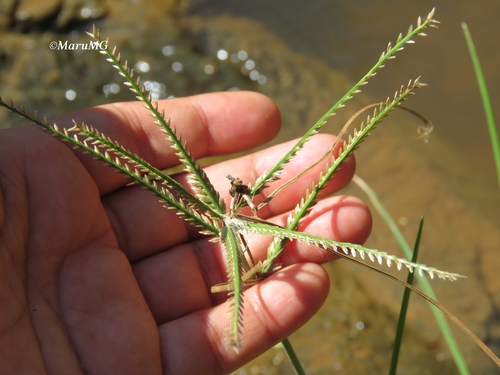
Eleusine is a genus of about nine annual and perennial grasses in the family Poaceae, native to the tropics and subtropics of Africa and Asia, with several species now naturalised worldwide. Plants form tufted clumps 12 to 48 in (30 to 120 cm) tall with flat or folded leaf blades and flattened, often bluish leaf sheaths. The flower heads are made up of two to several thick, finger-like spikes that radiate from the top of the stem, each crowded with two-ranked spikelets. E. coracana, finger millet, is a staple cereal grown across the drylands of eastern Africa and southern India, where its seed stores well and withstands drought. E. indica, goosegrass, is a tough weed of paths, lawns, and cultivated ground on most continents and resists pulling because of its strong fibrous roots. Most species are wind-pollinated C4 grasses adapted to heat and strong light. As a group they have little frost tolerance, and several behave as warm-season annuals. The weedy species can compete aggressively with crops and turf.
Native Range
Native to the tropical and subtropical grasslands of Africa and southern Asia. Several species, including goosegrass, have spread as weeds throughout the warmer regions of every inhabited continent.Suggested Uses
E. coracana is grown as a grain and fodder crop in semi-arid regions for its storable, gluten-free seed. The genus is otherwise met as weeds rather than as planted ornamentals. Seed of several species is eaten by birds.How to Identify
Appearance
Size & Dimensions
Height1' - 4'
Width/Spread6" - 1'6"
Bloom Information
Flowering and seed-set occur in the warm months, from summer into autumn in temperate areas and through the wet season in the tropics. The wind-pollinated flowers have no petals. Seed ripens quickly after flowering.
Detailed Descriptions
Flower Description
Green to strawFoliage Description
Green to bluish-greenGrowing Conditions
Sun Requirements
Requires 6-12 hours of direct sunlight daily
• Full Sun: 6+ hours of direct sunlight
• Partial Shade: 3-6 hours of direct sunlight
• Full Shade: Less than 3 hours of direct sunlight
Care & Maintenance
Care Guide
These grasses grow in full sun in almost any moderately fertile soil, from sand to clay loam, at a pH near 5.5 to 7.5. They are heat-adapted and drought-tolerant once rooted but are killed by frost. Finger millet is sown in warm soil and harvested before heavy rain to protect the ripe grain. The weedy species need no care and self-seed freely, which is why they persist in lawns and crops. Compacted soil does not stop them. Overhead watering supports establishment of cultivated stands.Pruning
No pruning is needed. Cultivated finger millet is cut at the base at harvest. In trial or ornamental plantings, old clumps can be cut to ground level before new growth resumes.Toxicity
Non-toxicPlanting Guide
Planting Methods & Timing
Planting Method
direct sow
Direct Sow Timing
Sow after the last frost once soil is warm
Days to Maturity
90–130 days
Plant Spacing
8 inches