Elephantopus, Genus, tomentosus, Species,
- Genus & species
common elephant's-foot
Overview
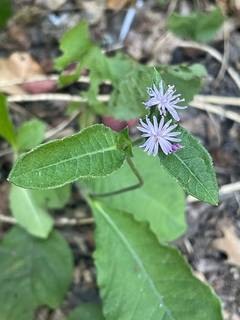
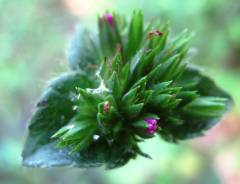
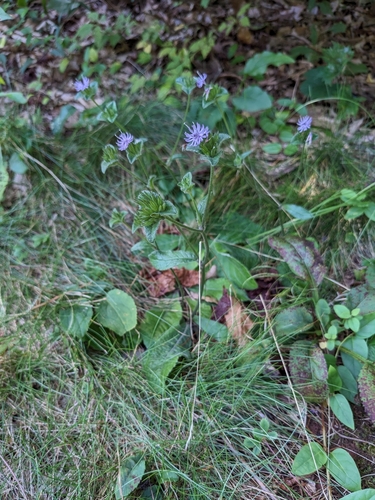
Elephantopus tomentosus is a herbaceous perennial in the aster family, forming a flat basal rosette of oblong to oblanceolate leaves 4-8 inches (10-20 cm) long, with a coarsely toothed margin and a densely hairy underside that gives the species its name. From the rosette a branched flowering stem rises 24-48 inches (60-120 cm), carrying small clusters of flower heads, each cupped by three leaf-like triangular bracts. Each head holds a few lavender to pale purple disc florets 0.2-0.3 inch (5-8 mm) long; there are no ray florets, so the heads read as tufts rather than daisies. The plant grows in dry to moderately moist woodlands, pine flatwoods, and clearings across the southeastern United States. It spreads slowly from a short woody rootstock and does not form runners, so colonies stay tight. Flowering occurs from late summer into autumn. The leaves are largely confined to the ground-level rosette, leaving the upper stem sparse, so the plant adds little visual mass and can be hard to locate among taller herbs once flowering ends.
Native Range
Native to the southeastern United States, from Virginia and Kentucky south to Florida and west to eastern Texas, mainly in the coastal plain and lower piedmont.Suggested Uses
Used in native plant gardens, woodland edges, and naturalized meadows in the southeastern United States. The basal rosette works as low groundcover under open canopy, while the wiry flower stems carry late-season nectar for small bees and butterflies. It tolerates dry shade where many perennials decline.How to Identify
Appearance
Size & Dimensions
Height2' - 4'
Width/Spread1' - 1'6"
Bloom Information
Flowering runs from August to October. Each head opens a small group of lavender to purple tubular florets that last a few days, with heads opening in succession over several weeks. Seed is shed as small bristly achenes carried a short distance by wind.
Detailed Descriptions
Flower Description
lavender to pale purpleFoliage Description
medium green above, gray-green and woolly beneathGrowing Conditions
Sun Requirements
Requires 3-8 hours of direct sunlight daily
• Full Sun: 6+ hours of direct sunlight
• Partial Shade: 3-6 hours of direct sunlight
• Full Shade: Less than 3 hours of direct sunlight