Overview
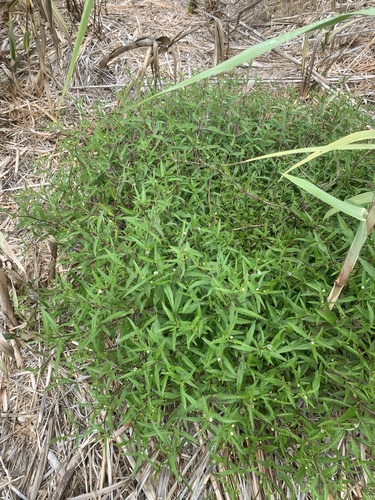
Eclipta prostrata is a fast-growing annual in the daisy family, with branching stems 4-24 inches (10-60 cm) long that sprawl along the ground and root at the nodes or grow more erect in crowded stands. The opposite, lance-shaped leaves are 1-4 inches (2.5-10 cm) long with rough short hairs and toothed margins. Through summer and autumn it produces many small flower heads about 0.25-0.4 inch (6-10 mm) wide, each ringed with numerous narrow white ray florets around a greenish-white disk. The seeds are small dark achenes without a parachute of bristles. It grows worldwide in warm regions and is naturalized across the southern and eastern United States, favoring wet, open ground such as ditches, pond edges, rice fields, and damp disturbed soil. It roots readily where stems touch moist ground and reseeds heavily, so it behaves as a weed in wet cultivated land. The plant has a long history in traditional Asian medicine, where it is known as bhringraj.
Native Range
Eclipta prostrata has a pantropical distribution and its exact origin is uncertain, though it is generally treated as native to warm regions of both the Old World and the Americas. In North America it occurs through the southern and eastern United States and is naturalized more widely.Suggested Uses
Grown in bog gardens, pond margins, and damp wildlife plantings where its spreading habit is acceptable. It is also raised in herb collections for its traditional medicinal use. In wet ground it forms quick groundcover but reseeds aggressively.How to Identify
Appearance
Size & Dimensions
Height4" - 2'
Width/Spread1' - 3'
Bloom Information
Detailed Descriptions
Foliage Description
greenGrowing Conditions
Sun Requirements
Requires 4-10 hours of direct sunlight daily
• Full Sun: 6+ hours of direct sunlight
• Partial Shade: 3-6 hours of direct sunlight
• Full Shade: Less than 3 hours of direct sunlight
Water & Climate
Water Needs
Care & Maintenance
Care Guide
Grow Eclipta prostrata in full sun to part shade in consistently moist to wet soil, including pond margins and boggy ground. It tolerates flooding and heavy, mucky soils and falters where the ground dries out. Seed is sown on the surface of damp soil in warm weather, as it needs moisture and warmth to germinate. No feeding is required in fertile wet soil. The stems root where they touch moist ground and seedlings appear freely, so it is contained or pulled where spread is unwanted. It dies with the first hard frost.Pruning
No structural pruning is required for this annual. Stems can be trimmed to limit their spread across moist ground. Plants are cleared after frost kills the top growth.Container Growing
Suitable for container growing
Minimum container size: 2 gallons
Toxicity
Non-toxicPlanting Guide
Planting Methods & Timing
Planting Method
direct sow
Plant Spacing
12 inches