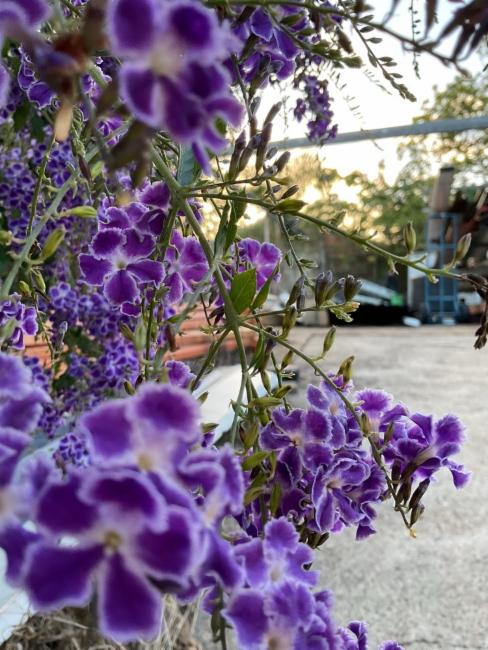
Duranta, Genus, spp., Multiple species,
- Genus
- Multiple species
golden dewdrops
Overview
Duranta is a genus of about 17 to 30 species of evergreen shrubs and small trees in the verbena family (Verbenaceae), native to the tropical and subtropical Americas. Plants form arching, spreading mounds 6 to 18 feet (1.8 to 5.5 m) tall and 4 to 12 feet (1.2 to 3.7 m) wide, with slender, sometimes thorny branches that droop under their own weight. The oval leaves are green, with gold-leaved and variegated forms in cultivation, and some species carry spines in the leaf axils. Small tubular flowers, about 0.5 inch (12 mm) across, open in long, loose, drooping clusters in blue, purple, lavender, or white over a long season. The flowers are followed by hanging clusters of round, glossy, golden-yellow berries 0.3 to 0.5 inch (8 to 12 mm) wide, which give the plant its common name of golden dewdrop. The leaves and berries contain saponins and other compounds and are toxic to people and animals if eaten. Plants grow in full sun in warm, frost-free climates and tolerate heat, humidity, and drought once established, but they are killed or cut back by frost and can self-seed into a weed in tropical regions.
Native Range
Duranta is native to the warm Americas, from Mexico, Florida, and the Caribbean through Central America into South America. D. erecta, the species most often grown, ranges naturally across Mexico, the Caribbean, and South America and has naturalized in warm regions worldwide.Suggested Uses
Duranta is used as a flowering hedge, screen, and specimen shrub in warm gardens, and gold-leaved forms are grown for foliage color. It is also grown as a container plant and a clipped standard. The toxic berries and frost sensitivity limit where it is planted near children, pets, and in cold-winter regions.How to Identify
Appearance
Size & Dimensions
Height6' - 18'
Width/Spread4' - 12'
Bloom Information
Duranta blooms over a long season in warm climates, from spring through fall and nearly year-round in frost-free areas. The drooping flower clusters open in succession, so flowers and ripening golden berries are often present at the same time. Flowering slows in cool weather and stops where frost cuts the plant back.
Detailed Descriptions
Flower Description
blue, purple, lavender, or whiteFoliage Description
green; some cultivars gold or variegatedGrowing Conditions
Sun Requirements
Requires 6-12 hours of direct sunlight daily
• Full Sun: 6+ hours of direct sunlight
• Partial Shade: 3-6 hours of direct sunlight
• Full Shade: Less than 3 hours of direct sunlight
Care & Maintenance
Care Guide
Duranta grows in full sun in warm, frost-free climates in moist, well-drained soil. Established plants tolerate heat, humidity, and short drought, and they bloom most heavily with steady warmth and regular water. Frost cuts the plants back or kills them, so in cooler zones they are grown in containers and overwintered indoors. The leaves and berries are toxic to people, pets, and livestock if eaten. Plants grow quickly and may need regular trimming to stay in bounds. In tropical regions the genus self-seeds readily and is treated as a weed in some areas.Pruning
Duranta is pruned in late winter or early spring to shape the plant and control its size, as it flowers on new growth. Hard pruning renews leggy, overgrown plants, and light trimming through the season keeps hedges dense. Frost-damaged stems are cut back to live wood once growth resumes.Container Growing
Suitable for container growing
Minimum container size: 5 gallons
