Duranta, Genus, erecta, Species,
- Genus & species
golden dewdrop
Florida, Mexico, Central America, the Caribbean, and South America from Brazil to northern Argentina; naturalized and invasive in Australia, South Africa, and parts of the Pacific
Overview
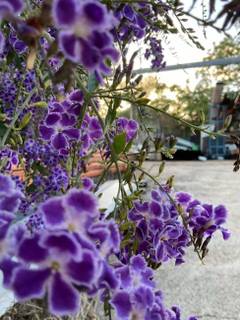
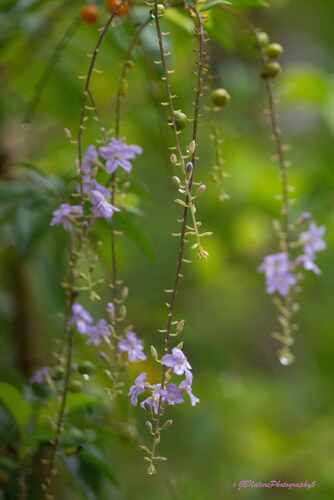
Duranta erecta is the golden dewdrop — a tropical and subtropical flowering shrub or small tree from the Caribbean and the Americas, growing 6–18 ft (1.8–5.5 m) tall and 4–10 ft (1.2–3 m) wide outdoors, with smaller container forms reaching 36–60 inches (90–150 cm). The species is native to Florida, Mexico, the Caribbean, and South America from Brazil to northern Argentina, and has been widely planted across the global tropics. Two ornamental features carry the year-round display: drooping racemes 4–8 inches (10–20 cm) long of small lavender-blue to violet five-petaled flowers 0.4–0.5 inch (10–13 mm) across with darker corolla margins, appearing year-round in zones 10–11 and from spring through autumn elsewhere; and pendant clusters of yellow-orange berries that develop after flowering and persist on the plant simultaneously with new flowers, giving the cultivar its 'golden dewdrop' common name. Foliage is composed of glossy oval medium green leaves 1.5–3 inches (4–8 cm) long with a serrated margin, arranged opposite along woody stems that bear sharp 0.4–0.6 inch (10–15 mm) thorns at the leaf axils on wild forms (some cultivated selections such as 'Sapphire Showers' have reduced or absent thorns). The yellow-orange berries are toxic and contain saponins; ingestion in dogs causes vomiting, diarrhea, hyperthermia, and seizures, and human ingestion has caused fatalities in children, with the unripe and ripe berries both toxic. The species is classified as invasive in Australia, South Africa, and parts of the Pacific. Hardy outdoors only in USDA zones 8b–11; foliage drops at 28°F (−2°C) and the plant dies in temperatures below 20°F (−6°C).
Native Range
Duranta erecta is native to Florida, Mexico, Central America, the Caribbean, and South America from Brazil to northern Argentina, where it grows in dry to moist scrubland, along forest edges, and on disturbed open ground at low to mid elevations. The species is naturalized and classified as invasive in Australia, South Africa, parts of the Pacific, and other warm regions outside its native range.Suggested Uses
Used as a tropical hedge, a flowering specimen shrub, or a small tree in zones 8b–11 mixed plantings, and in containers of 5–10 gallons (19–38 liters) for patio culture in colder zones with indoor overwintering. The simultaneous flower-and-berry display draws hummingbirds and butterflies year-round in tropical climates. Less suited to households with children, dogs, or cats with outdoor access due to berry toxicity, and unsuited to regions where the species is invasive (Australia, South Africa, parts of the Pacific).How to Identify
Appearance
Size & Dimensions
Height6' - 18'
Width/Spread4' - 10'
Bloom Information
Flowers year-round in USDA zones 10–11 and from spring through autumn (about 28 weeks) in zones 8b–9 where winter cold halts flowering. Drooping racemes of small lavender-blue to violet flowers with darker corolla margins, followed by yellow-orange berries that develop and persist alongside subsequent flowers. Carries no significant fragrance.
Detailed Descriptions
Flower Description
Drooping racemes 4-8 inches (10-20 cm) long of small lavender-blue to violet five-petaled flowers 0.4-0.5 inch (10-13 mm) across with darker corolla marginsFoliage Description
Glossy oval medium green leaves 1.5-3 inches (4-8 cm) long with a serrated margin, arranged opposite along woody stemsGrowing Conditions
Sun Requirements
Requires 6-12 hours of direct sunlight daily
• Full Sun: 6+ hours of direct sunlight
• Partial Shade: 3-6 hours of direct sunlight
• Full Shade: Less than 3 hours of direct sunlight
Care & Maintenance
Care Guide
Place in full sun for 6 or more hours daily; the plant tolerates partial shade in hot tropical climates but flowers more sparsely there. Soil should be well-drained, slightly acidic to neutral (pH 5.5–7.5), and of medium fertility; the plant grows in sandy, loamy, and rocky soils. Water during the first year of establishment, then irrigate during prolonged drought; mature plants tolerate moderate drought. Maintain temperatures above 28°F (−2°C) for evergreen foliage; brief frost causes leaf drop and the plant resprouts from woody stems in spring. The species is classified as invasive in Australia, South Africa, and parts of the Pacific, and the toxic berries are a poisoning risk for households with children, dogs, or cats with outdoor access. Feed lightly during the first 2–3 years of establishment with a balanced fertilizer in spring; mature plants rarely need feeding. Prune to shape after the main bloom or in early spring before new growth pushes; the species responds well to hard cutbacks and resprouts vigorously.Pruning
Prune lightly to shape after the main bloom in summer or early autumn, or hard-prune in early spring before new growth pushes; the species responds well to renewal cuts and resprouts vigorously. Remove crossing or damaged branches at the base. Hard cutbacks can be used to maintain a compact 4–6 ft (1.2–1.8 m) hedge form rather than allowing the natural 12–18 ft (3.6–5.5 m) tree-like growth.Pruning Schedule
Prune: March & August–September
early springsummerfall
Container Growing
Suitable for container growing
Minimum container size: 5 gallons