Dudleya, Genus, lanceolata, Species,
- Genus & species
lanceleaf liveforever
Southern California and Baja California
Overview
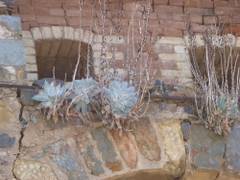
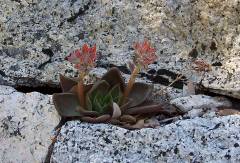
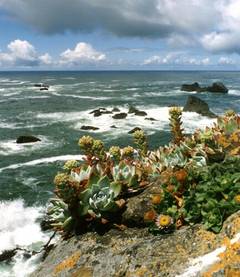
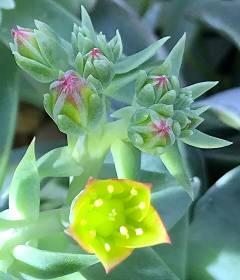
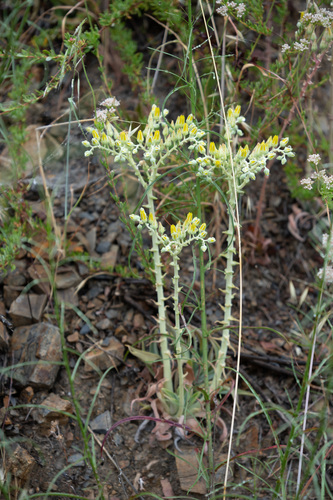
Dudleya lanceolata is an evergreen succulent in the Crassulaceae that forms a basal rosette of fleshy, lance-shaped leaves 4-12 inches (10-30 cm) long. The leaves are green to grey-green with a faint waxy bloom and often flush red or purple under drought and strong sun. Each rosette spans 6-18 inches (15-45 cm) and rises from a thick, partly woody stem base. In late spring and summer, branched flower stalks 12-30 inches (30-75 cm) tall carry tubular flowers in shades of pale yellow through orange to deep red, each about 0.5 inch (12 mm) long with five erect petals. The plant is adapted to summer drought: rosettes contract and lower leaves dry as soil moisture falls, then refill with autumn and winter rain. It grows on dry rocky slopes, canyon walls, and coastal bluffs, rooting in thin mineral soil and rock crevices. Overwatering and poorly drained soil cause rapid rot, the main limitation in cultivation, and the dried lower leaves persist as a skirt around the base unless removed.
Native Range
Native to southern California and northern Baja California, Mexico, from the coast through the Transverse and Peninsular Ranges. It grows on dry rocky slopes, canyon walls, road cuts, and coastal bluffs, usually in thin soil over rock between sea level and about 5,000 feet (1,500 m).Suggested Uses
Used in rock gardens, succulent plantings, green roofs, and dry coastal or Mediterranean-climate borders, spaced 8-12 inches (20-30 cm) apart. It suits containers, crevice gardens, and unirrigated slopes, and is poorly suited to lawns, irrigated beds, or humid summer climates.How to Identify
Appearance
Size & Dimensions
Height1' - 2'6"
Width/Spread6" - 1'6"
Bloom Information
Flowering runs from late spring into summer, mainly May to July. Tall branched stalks open tubular flowers over several weeks, with colour ranging from pale yellow to orange-red between populations. After seed set the stalks dry and persist into the following season.
Detailed Descriptions
Flower Description
pale yellow to red-orangeFoliage Description
green to grey-green, often red-tingedGrowing Conditions
Sun Requirements
Requires 6-12 hours of direct sunlight daily
• Full Sun: 6+ hours of direct sunlight
• Partial Shade: 3-6 hours of direct sunlight
• Full Shade: Less than 3 hours of direct sunlight
Care & Maintenance
Care Guide
Grows in full sun to light afternoon shade in fast-draining rocky, sandy, or gritty soil with a pH near 6.0-7.5. Water needs are very low; established plants rely on winter rain and stay nearly dry through their summer dormancy. Summer irrigation in warm soil is the most common cause of crown and root rot. Container plants grow well in a mineral cactus mix with the rosette crown kept above the soil line. Plants are frost-tender and live outdoors year-round only in USDA zones 9-11, overwintering under cover in colder areas.Pruning
Needs almost no pruning. Dried lower leaves and spent flower stalks are removed after bloom to keep the rosette clean and reduce shelter for pests. Offsets can be separated in autumn to propagate plants or limit clump size.Pruning Schedule
Prune: July–August
summer
Container Growing
Suitable for container growing
Minimum container size: 1 gallons