Image 1 of 8
1 / 8
© Harry Rose from South West Rocks, Australia, some rights reserved (CC-BY) · Wikimedia Commons
Diuris, Genus, orientis, Species,
- Genus & species
wallflower orchid
South-eastern Australia (Victoria, South Australia, Tasmania)
Overview
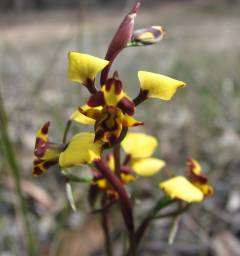
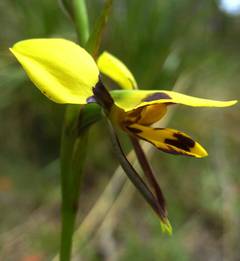
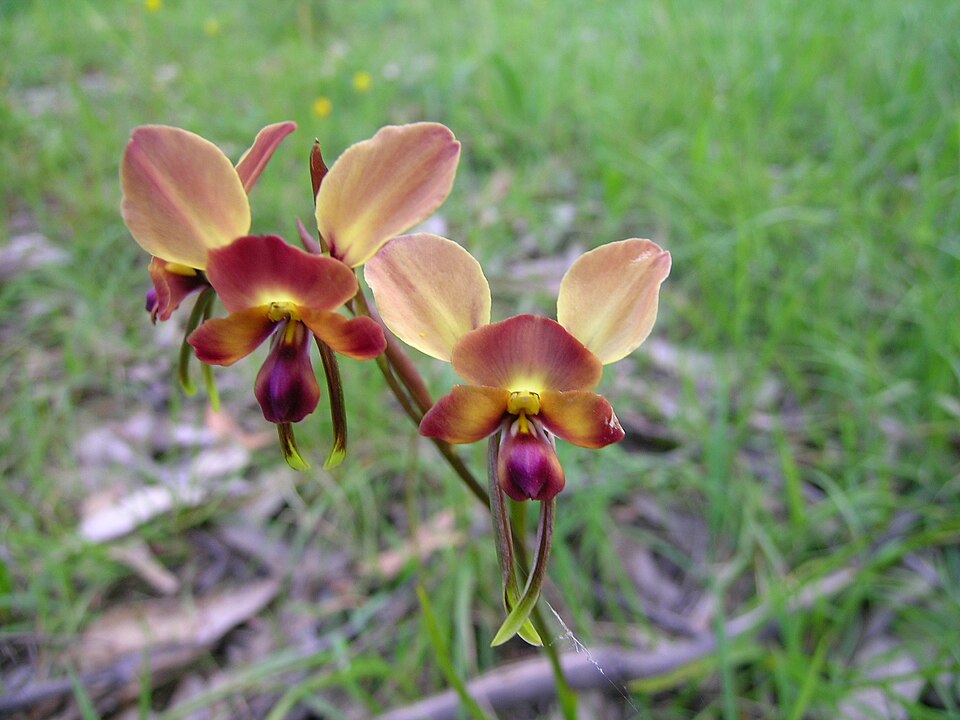
Diuris orientis is a terrestrial tuberous orchid in the family Orchidaceae, growing 4-12 inches (10-30 cm) tall from an underground tuber. Each plant produces two to four narrow, grass-like leaves at the base and a slender stem carrying one to several flowers. The flowers are about 0.8-1.4 inches (2-3.5 cm) across, yellow marked with brown, mauve, and purple, with two erect upper petals and lateral petals that spread like ears, giving the donkey-orchid group its name. Flowering occurs in spring. Like many terrestrial orchids, it depends on a partnership with specific soil fungi to germinate and grow, and the flowers mimic nearby pea-flowers to attract pollinating bees without offering nectar. It grows in open forest, woodland, and grassland across Victoria, South Australia, and Tasmania, on well-drained soils. The plant grows through the cool, wet months and dies back to its tuber over the dry summer. It tolerates frost while dormant. The orchid is slow to establish, depends on its fungal partner, and cannot be transplanted as a normal garden perennial. Above-ground growth lasts only a few months, and the plant disappears entirely in summer.
Native Range
Diuris orientis is native to south-eastern Australia, in Victoria, South Australia, and Tasmania. It grows in open forest, woodland, and grassland on well-drained soils.Suggested Uses
Grown by terrestrial-orchid specialists in pots and dedicated beds with the right soil fungi and a seasonal wet-dry cycle. It features in native orchid collections and conservation plantings. The flowers draw native bees through floral mimicry.How to Identify
Appearance
Size & Dimensions
Height4" - 1'
Width/Spread2" - 6"
Bloom Information
Yellow and brown flowers open in spring, roughly August to October in the native range, one to several on each stem. The blooms mimic nearby pea-flowers to draw pollinating bees. The plant dies back to its tuber once flowering and seeding finish.
Detailed Descriptions
Flower Description
yellow with brown and purple markingsFoliage Description
greenGrowing Conditions
Sun Requirements
Requires 4-8 hours of direct sunlight daily
• Full Sun: 6+ hours of direct sunlight
• Partial Shade: 3-6 hours of direct sunlight
• Full Shade: Less than 3 hours of direct sunlight
Care & Maintenance
Care Guide
The orchid grows in open, sunny to lightly shaded sites in moist, well-drained soil through the cool months, dying back to a tuber over the dry summer. It depends on specific soil fungi to germinate and grow, so it does not establish from a bare transplanted tuber in ordinary garden soil. No fertiliser is used, as the natural soil association supplies its needs. Frost is tolerated during dormancy. Specialist growers raise it in pots with the correct fungal partner and a winter-wet, summer-dry cycle. The summer-dormant ground is kept dry to prevent tuber rot.Pruning
No pruning is needed. Spent flower stems can be left to set seed or removed once flowering ends. The plant withdraws to its tuber on its own and reshoots in autumn.Container Growing
Suitable for container growing