Disanthus, Genus, cercidifolius, Species,
- Genus & species
disanthus
Japan (Honshu, Shikoku) and southeastern China (Zhejiang, Jiangxi; moist acidic mountain forests at 2,000-5,000 feet)
Overview
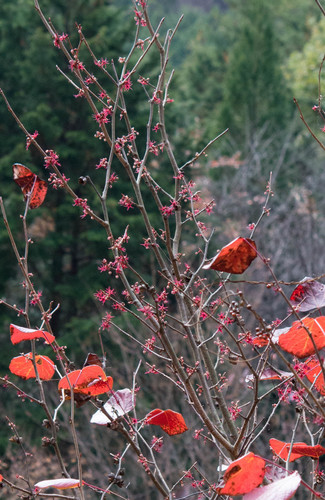
Disanthus cercidifolius is a spreading multi-stemmed deciduous shrub in the witch-hazel family (Hamamelidaceae) reaching 6–10 feet (1.8–3 m) tall with a spread of 6–10 feet (1.8–3 m). This monotypic Japanese-and-Chinese species is grown primarily for fall foliage color — the rounded heart-shaped leaves 2–4 inches (5–10 cm) across resemble Cercis (redbud) leaves, which the specific epithet 'cercidifolius' references directly, and they turn vivid shades of crimson, scarlet, orange, and purple in autumn. Summer foliage is medium to dark blue-green with a slight glaucous quality that reads cooler than most deciduous shrub foliage. Small dark red to maroon spider-like flowers 0.5 inch (1 cm) across open in pairs in October–November, which is an uncommon bloom timing — most shrubs flower during or before leaf-out, not alongside fall color. Flowers are inconspicuous relative to the fall foliage display and carry a faint fragrance. Habit is wide-spreading and layered with horizontal branching that creates a tiered silhouette readable through winter. Growth rate is slow. Acidic moist well-drained soil is required — cultural requirements closely match Hamamelis (witch hazel), to which Disanthus is closely related. Hardy to zone 5.
Native Range
Disanthus cercidifolius is native to Japan (Honshu, Shikoku) and southeastern China (Zhejiang, Jiangxi), where it occurs in moist acidic mountain forests at 2,000–5,000 feet (600–1,500 m). The genus is monotypic — D. cercidifolius is the only species in Disanthus.Suggested Uses
Grown as a specimen shrub or within woodland borders at 6–8 foot (1.8–2.4 m) spacing. The wide-spreading layered habit and vivid fall color place this species in prominent positions where the October–November display can be viewed from primary garden vantages — deliberate front-of-border siting serves this shrub far better than back-of-border placement where the fall color cannot be seen at close range. Woodland-garden edges receive the filtered light that supports both form and color. Pairing with other acid-loving fall-interest plants such as Hamamelis, Fothergilla, and Enkianthus builds a coordinated autumn-color composition on matching soil chemistry. Full-sun sites in hot climates, dry soils, alkaline planting contexts, and locations where the slow growth and 6–10 foot wide spread cannot be accommodated are not suitable.How to Identify
Appearance
Size & Dimensions
Height6' - 10'
Width/Spread6' - 10'
Bloom Information
Small paired dark red to maroon spider-like flowers 0.5 inch (1 cm) across open in October–November, often during or immediately after the fall color display. Bloom duration is 2–3 weeks. Flowers carry a faint fragrance and are inconspicuous relative to the autumn foliage color. The overlap of flowering and fall color is an uncommon scheduling pattern — most deciduous shrubs flower earlier in the season, not alongside leaf coloration.
Detailed Descriptions
Flower Description
Dark red to maroon small spider-like paired 0.5 inch; faintly fragrantFoliage Description
Medium to dark blue-green rounded heart-shaped 2-4 inches across; vivid crimson-scarlet-orange-purple fall colorGrowing Conditions
Sun Requirements
Requires 3-6 hours of direct sunlight daily
• Full Sun: 6+ hours of direct sunlight
• Partial Shade: 3-6 hours of direct sunlight
• Full Shade: Less than 3 hours of direct sunlight
Care & Maintenance
Care Guide
Grows in partial shade in moist well-drained acidic humus-rich soil at pH 5.0–6.5, tolerating loam and peat. Hardy to zone 5. Consistent moisture is required through the growing season — drought produces leaf scorch and reduces fall-color intensity. Fall color develops most vividly in partial shade with some direct sun exposure, which balances photosynthetic productivity against leaf-pigment stress signals. Strong winds desiccate the foliage and should be blocked by surrounding structure when possible. Slow growth rate holds through the full mature lifespan. No serious pest or disease problems. Cultural requirements closely match Hamamelis — the two genera make reliable companion plantings on the same acidic moist woodland-margin soils.Pruning
Minimal pruning is required. Dead or crossing branches are removed in late winter (February). The natural layered spreading habit is the desired form; shearing or heavy shaping destroys the tiered silhouette that is this species primary winter ornamental feature. Slow growth means pruning cuts fill in slowly, so the gardener errs toward light touch rather than major restructuring.Pruning Schedule
Prune: February
winter