Dirca, Genus, palustris, Species,
- Genus & species
eastern leatherwood
Overview
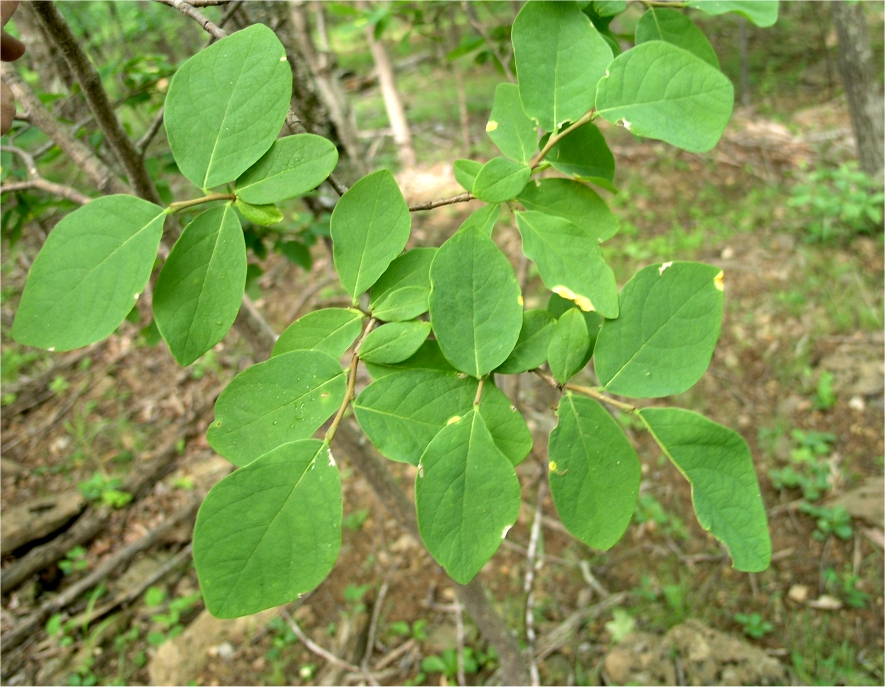
A slow-growing deciduous shrub reaching 3–6 feet (0.9–1.8 m) tall and wide, with a rounded, densely branched form. The branches are flexible and tough, covered in a leathery bark that resists breaking, and they are swollen at the joints where the leaves attach. Leaves are alternate, oval to obovate, 2–3 inches (5–8 cm) long, light green and smooth, turning clear yellow in fall. Small pale yellow tubular flowers, each about 0.3 inch (8 mm) long, hang in clusters of two to four along the bare branches in early spring before the leaves emerge. The flowers lack true petals, consisting of a tubular calyx with protruding stamens. Pale green to reddish oval fruits about 0.4 inch (10 mm) long ripen by early summer and drop soon after. The shrub grows from shallow roots and adds only 1–4 inches (2.5–10 cm) of new growth per year, taking 15–20 years to reach full size. Bark and twigs contain irritant compounds that can cause skin and digestive irritation if handled or chewed. Foliage drops early in dry autumns.
Native Range
Native to eastern North America from New Brunswick and Ontario south to Florida and west to Minnesota, Missouri, and Louisiana. Grows as an understory shrub in moist, rich deciduous forests, on wooded slopes, in ravines, and on floodplains in shaded, well-drained soils.Suggested Uses
Grown in shade gardens, woodland borders, and native plant collections at 4–6 foot (1.2–1.8 m) spacing. Used as an early-spring-flowering understory shrub beneath deciduous trees. Suited to moist shaded sites and not to open, sunny, or dry locations.How to Identify
Appearance
Size & Dimensions
Height3' - 6'
Width/Spread3' - 6'
Bloom Information
Flowers open in March and April on bare branches before the leaves emerge, two to four weeks ahead of most associated forest shrubs. Bloom lasts about 2 weeks. In the southern range flowering may begin in late February, while in the north it occurs into early May. Cool spring weather lengthens the display.
Detailed Descriptions
Foliage Description
Light green, turning clear yellow in fallGrowing Conditions
Sun Requirements
Requires 2-5 hours of direct sunlight daily
• Full Sun: 6+ hours of direct sunlight
• Partial Shade: 3-6 hours of direct sunlight
• Full Shade: Less than 3 hours of direct sunlight
Care & Maintenance
Care Guide
Grows in partial to full shade in moist, humus-rich, well-drained soils, matching its native forest understory. Water during dry spells, as the shallow roots are sensitive to drought and summer heat. It grows poorly in full sun, compacted soil, or hot exposed sites. The plant rarely suffers serious pests or diseases. Transplanting is difficult because of the brittle root system, and container-grown plants establish more reliably than bare-root divisions. Bark and twigs contain irritant compounds that can cause skin irritation on contact.Pruning
Little pruning is needed because of the slow growth rate. Dead or damaged branches can be removed in late winter or after flowering. Hard pruning regrows slowly and may take several years to replace. Shaping is rarely required.Pruning Schedule
Prune: February & April
winterearly spring