Daviesia, Genus, brevifolia, Species,
- Genus & species
leafless bitter-pea
Overview
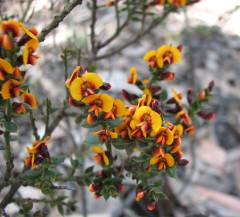
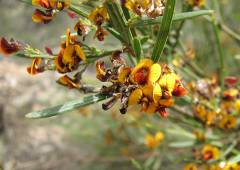
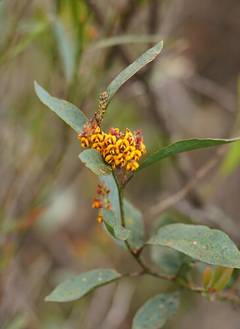
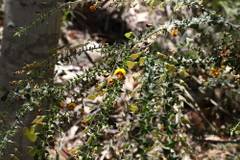
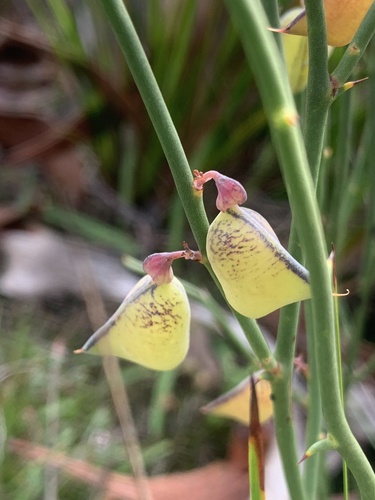
An evergreen shrub reaching 1.5-5 feet (0.5-1.5 m) tall and 2-5 feet (0.6-1.5 m) wide, with a dense, rigid, intricately branched habit. The branchlets are stiff and end in sharp points, and the leaves are reduced to small, narrow phyllodes 0.2-0.6 inch (5-15 mm) long, giving an almost leafless appearance. Pea-shaped flowers 0.3-0.4 inch (8-10 mm) across are yellow to orange with red markings, borne in small clusters along the branchlets in spring. Fruit a small triangular pod 0.2-0.3 inch (5-8 mm) long holding one or two seeds. Growth is slow to moderate. The rigid spiny branchlets form a dense, prickly mass. Lower branches become bare with age.
Native Range
Native to southern Australia in South Australia, Victoria, and Tasmania. Grows in mallee, heathland, and dry sclerophyll woodland on sandy and gravelly well-drained soils in low-rainfall areas.Suggested Uses
Planted as a low barrier or habitat shrub in dry native gardens at 3-5 foot (0.9-1.5 m) spacing. The dense spiny habit creates shelter and nesting sites for small birds. Suits low-water and revegetation plantings on poor soils.How to Identify
Appearance
Size & Dimensions
Height1'6" - 5'
Width/Spread2' - 5'
Bloom Information
Detailed Descriptions
Flower Description
Yellow to orange with red markingsFoliage Description
GreenGrowing Conditions
Sun Requirements
Requires 6-10 hours of direct sunlight daily
• Full Sun: 6+ hours of direct sunlight
• Partial Shade: 3-6 hours of direct sunlight
• Full Shade: Less than 3 hours of direct sunlight
Care & Maintenance
Care Guide
Water occasionally through the first summer to establish; mature plants are drought tolerant and need little irrigation. Grows in full sun on free-draining sandy or gravelly soils. As a legume, it fixes nitrogen through root nodules and grows in low-fertility ground. Prolonged waterlogging causes root rot. Few pests occur in dry, open positions.Pruning
Prune lightly after flowering to maintain shape, cutting within green growth. The rigid spiny branchlets make handling difficult. Cutting into old bare wood produces slow regrowth. Tip-pruning young plants encourages density.Pruning Schedule
Prune: November–December
spring