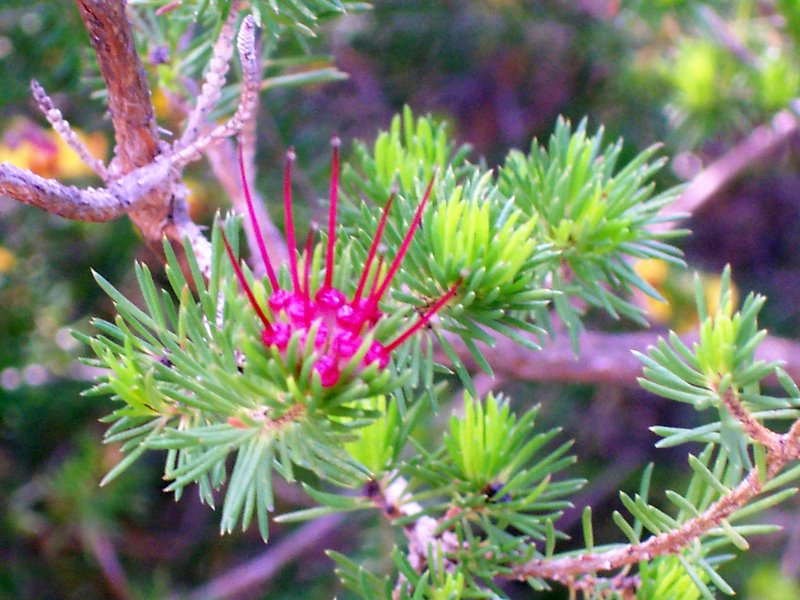
Darwinia, Genus, fascicularis, Species,
- Genus & species
clustered darwinia
Overview
Darwinia fascicularis is a small evergreen shrub in the myrtle family, growing 12-60 inches (30-150 cm) tall and 24-48 inches (60-120 cm) wide, with an upright to spreading, sometimes sprawling habit. The narrow, needle-like leaves are 0.2-0.6 inch (5-15 mm) long, crowded along the stems, and aromatic when crushed. Tubular flowers about 0.3-0.5 inch (8-12 mm) long are packed into rounded terminal clusters, opening greenish-white to cream and aging to pink or red, with slender styles projecting beyond the petals. Flowering is mainly in winter and spring, and the colour change as flowers age gives clusters a two-tone look. Small dry fruits follow. Growth is moderate, and plants reach full size in three to four years. The species needs sharp drainage and full light, and is short-lived on heavy or poorly drained soils.
Native Range
Native to New South Wales in eastern Australia, concentrated on the sandstone country around Sydney. It grows in heath and dry sclerophyll woodland on shallow, sandy, low-nutrient soils, often in exposed sites.Suggested Uses
Used in native gardens, rockeries, and low borders on well-drained sandy soils, spaced 24-36 inches (60-90 cm) apart. Suits coastal and low-water plantings and containers with free-draining mix. The winter-to-spring flowers draw nectar-feeding birds.How to Identify
Appearance
Size & Dimensions
Height1' - 5'
Width/Spread2' - 4'
Bloom Information
Flowers mainly in winter and spring (June to October), with the heaviest flush in late winter. Clusters hold their flowers for several weeks as the colour shifts from cream to red. Scattered flowers can appear outside the main season in mild conditions.
Detailed Descriptions
Flower Description
greenish-white aging to pink-redFoliage Description
greenGrowing Conditions
Sun Requirements
Requires 5-9 hours of direct sunlight daily
• Full Sun: 6+ hours of direct sunlight
• Partial Shade: 3-6 hours of direct sunlight
• Full Shade: Less than 3 hours of direct sunlight
Care & Maintenance
Care Guide
Grows in full sun to light shade on sharply drained sandy or gravelly soils that are low in phosphorus. Light watering through the first year aids establishment; mature plants tolerate dry periods and resent heavy, wet soils, which cause root rot. The species is short-lived on rich or poorly drained ground but persists for several years on lean, open sites. Tip pruning after flowering keeps growth compact and slows the open, woody habit that develops with age. Only low-phosphorus native fertilizer is suitable, applied lightly. Root-rot fungi are the main cause of sudden plant loss.Pruning
Light tip pruning after flowering keeps the shrub dense and compact and removes spent flower clusters. The plant reshoots from younger wood but only slowly from bare older stems, so hard cutting back is risky. Regular light trimming maintains a better shape than occasional heavy pruning.Pruning Schedule
Prune: October–November
late spring
Container Growing
Suitable for container growing
Minimum container size: 5 gallons