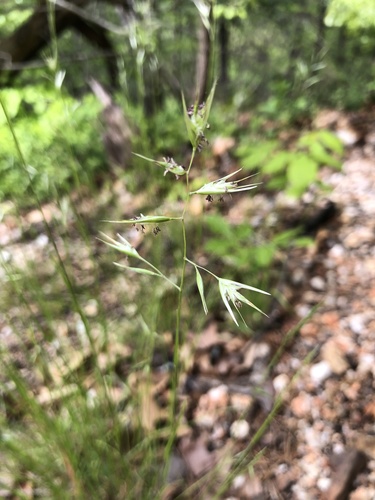
Danthonia, Genus, spicata, Species,
- Genus & species
poverty oat grass
Eastern and central North America; disjunct in Rocky Mountains and Pacific Northwest
Overview
Danthonia spicata is a perennial cool-season bunchgrass reaching 8-24 inches (20-60 cm) tall in flower and 6-12 inches (15-30 cm) wide, forming dense low tufts of narrow basal foliage. Leaves are narrow, 0.04-0.08 inch (1-2 mm) wide, blue-green to gray-green, becoming curled or wavy after summer drought stress. Flowering culms are slender, upright to slightly arching, and bear small open panicles of 4-12 spikelets; each spikelet is awned with a twisted dark awn 0.2-0.4 inch (5-10 mm) long. Bloom occurs from May through July, with seed dispersal extending into August. Cleistogamous (self-pollinating) flowers also develop within the lower leaf sheaths, yielding a second seed crop. Plants form discrete clumps that gradually expand without rhizomatous spread; mature clumps reach 8-12 inches (20-30 cm) wide within 3-5 years. Tolerates poor, dry, acidic soils where many grass species fail; the species' tolerance for sterile sites is the basis for its common name.
Native Range
Native across eastern and central North America from Newfoundland and Quebec south to Florida, west to Manitoba and Texas, with disjunct populations in the Rocky Mountains and Pacific Northwest. Grows on dry, sterile, acidic soils: glades, rock outcrops, sandy oak-pine woodlands, abandoned agricultural fields, and roadsides at elevations from sea level to 4,500 feet (1,400 m).Suggested Uses
Used in dry meadow plantings, prairie restorations, and low-input groundcover plantings on poor soils, spaced 12-15 inches (30-38 cm) apart. Plantings combine with Schizachyrium scoparium, Pycnanthemum tenuifolium, and Asclepias tuberosa on sandy or rocky sites. Tolerates compacted soils, occasional foot traffic, and roadside salt at low to moderate concentrations.How to Identify
Appearance
Size & Dimensions
Height8" - 2'
Width/Spread6" - 1'
Colors
Bloom Information
Blooms May through July across the range, with peak in June at mid-latitudes. Open-flowering panicles last 3-4 weeks; cleistogamous flowers develop continuously through the growing season. Pollen and seed dispersal occur from late June through August.
Detailed Descriptions
Foliage Description
blue-green to gray-green; curled in droughtGrowing Conditions
Sun Requirements
Requires 5-9 hours of direct sunlight daily
• Full Sun: 6+ hours of direct sunlight
• Partial Shade: 3-6 hours of direct sunlight
• Full Shade: Less than 3 hours of direct sunlight
Care & Maintenance
Care Guide
Plantings establish in dry, infertile, well-drained acidic soils. Water at planting and during the first growing season; established plants tolerate drought of 4-6 weeks without dormancy. Few pest or disease problems occur. Plants persist in soils with pH 4.5-6.5 where many ornamental grasses fail; alkaline or fertile soils typically reduce performance. Self-seeding is moderate in open soil and supports natural colony formation. Fertilization is not required and reduces drought tolerance.Pruning
Old foliage is cut to 2-3 inches (5-7.5 cm) above the crown in late winter before new growth begins, or left uncut for habitat value with no impact on plant health. Mid-season grooming is not required. Spent flowering culms can be removed in late summer or left through winter for visual interest.Pruning Schedule
Prune: February–March
winterearly spring
Container Growing
Suitable for container growing
Minimum container size: 2 gallons