Dalea, Genus, purpurea, Species,
- Genus & species
purple prairie clover
Great Plains and prairies, central North America
Overview
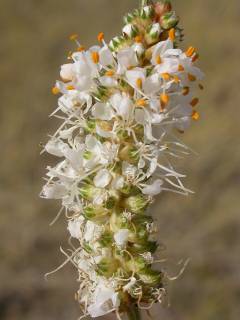
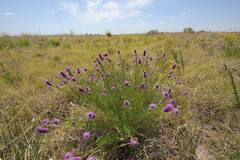
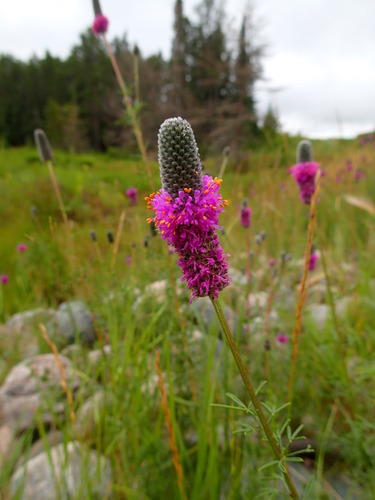
Dalea purpurea is a clump-forming perennial legume 1-3 feet (30-90 cm) tall that grows from a deep woody taproot. Several wiry, ridged stems rise from the base, each carrying alternate pinnately compound leaves divided into 3-7 narrow leaflets 0.4-0.8 inch (10-20 mm) long that fold upward in heat. From early to mid summer, dense cylindrical flower spikes 0.5-2 inches (1.5-5 cm) long form at the stem tips, with rose-purple to magenta flowers opening in a ring that climbs from the base of the spike to the top over one to two weeks. Each small flower has five petals and bright orange anthers that contrast with the purple. As a legume it fixes nitrogen through root-borne bacteria and grows on lean soils where other forbs thin out. The taproot reaches 5-6 feet (1.5-1.8 m) deep, anchoring plants on dry prairie and making established clumps hard to transplant. Seeds form in small one-seeded pods. One trade-off is slow establishment, since seedlings spend the first season building root rather than top growth.
Native Range
Native to the prairies and plains of central North America, from Saskatchewan and Manitoba south through the Great Plains to Texas and east to Indiana and Tennessee. It grows on dry to mesic prairie, limestone glades, and open rocky ground.Suggested Uses
Used in prairie restorations, native meadows, pollinator plantings, and dry sunny borders. It is grown as forage and as a nectar source in mixed grassland seedings.How to Identify
Appearance
Size & Dimensions
Height1' - 3'
Width/Spread1' - 1'6"
Bloom Information
Spikes bloom from June to August, with each spike flowering over one to two weeks as the ring of open flowers moves upward. A stand carries bloom for four to six weeks overall. Bees and other pollinators work the spikes heavily during this period.
Detailed Descriptions
Flower Description
Rose-purple to magenta with orange anthersFoliage Description
GreenGrowing Conditions
Sun Requirements
Requires 6-12 hours of direct sunlight daily
• Full Sun: 6+ hours of direct sunlight
• Partial Shade: 3-6 hours of direct sunlight
• Full Shade: Less than 3 hours of direct sunlight
Care & Maintenance
Care Guide
Grows in full sun in well-drained sandy, loamy, gravelly, or rocky soils at pH 6.0-8.0. It tolerates drought and lean ground once the taproot is set, fixes its own nitrogen, and declines in rich, wet, or shaded sites. Hardy in zones 3-8, it needs no fertilizer and little water after the first year. Seed germinates most reliably after cold-moist stratification and light scarification, and seedlings build root before top growth. Plants are slow to establish but long-lived, and the deep taproot makes mature clumps difficult to move.Pruning
Maintenance is minimal once plants are established. Spent spikes can be left to set seed for self-sowing or sheared off to keep a tidy form. Stems are cut to the ground in late winter before new growth begins.Pruning Schedule
Prune: February–March
winter