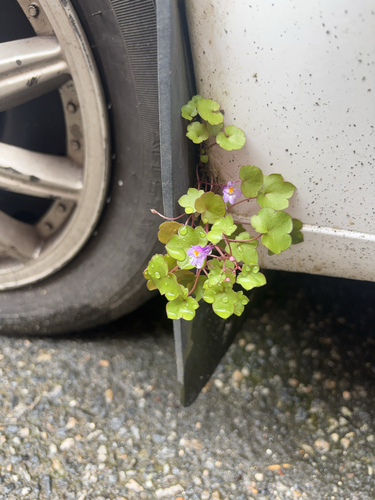
Cymbalaria, Genus, muralis, Species,
- Genus & species
ivy-leaved toadflax
Overview
Cymbalaria muralis is a slender, mat-forming perennial in the plantain family that trails over walls, rocks, and ground from thin, branching stems. The small leaves, 0.4-1 inch (1-2.5 cm) across, are rounded with five to seven shallow lobes, resembling ivy, and are often tinged purple on the undersides. From spring through autumn it produces many small two-lipped flowers about 0.4-0.6 inch (9-15 mm) long, lilac to violet with a white and yellow throat, held singly on slender stalks. After each flower is pollinated, its stalk bends away from the light and pushes the developing seed capsule back into shaded wall crevices, which is how the plant colonizes masonry. Native to the Mediterranean region, it has naturalized on old walls, rockeries, and paving across Europe, North America, and other temperate areas. It grows in little soil, tolerating drought, lime, and shade, and roots from trailing stems wherever they touch a crack. The trailing growth can self-seed widely and spread into mortar joints and gravel, which may be unwanted on garden walls.
Native Range
Native to the Mediterranean region of southern Europe. It has naturalized widely on walls, rockeries, and disturbed stony ground throughout temperate Europe, North America, Australia, and New Zealand.Suggested Uses
Grown on retaining walls, in rock gardens, between paving, and in containers and hanging baskets where the stems can trail. It softens stonework and fills shaded crevices that many plants cannot root in. The small leaves and flowers are edible, with a peppery, watercress-like taste.How to Identify
Appearance
Size & Dimensions
Height2" - 3"
Width/Spread1' - 2'
Bloom Information
Flowers over a very long season from spring into autumn, roughly April through October in mild areas. The small lilac flowers are visited by bees and other small insects. After flowering, the seed stalks curl away from light to lodge seeds in nearby crevices.
Detailed Descriptions
Flower Description
Lilac to violet with a yellow throatFoliage Description
Green, often purplish beneathGrowing Conditions
Sun Requirements
Requires 2-6 hours of direct sunlight daily
• Full Sun: 6+ hours of direct sunlight
• Partial Shade: 3-6 hours of direct sunlight
• Full Shade: Less than 3 hours of direct sunlight
Care & Maintenance
Care Guide
Grows in sun or shade in gritty, sharply drained soil, lime mortar, or rock crevices, tolerating a pH from about 6.0 to 8.0. Needs very little water once established and withstands drought on thin substrates. Roots freely from trailing stems and self-sows into cracks, spreading without help. Needs no feeding and little care beyond pulling back growth that strays too far. Hardy through cold winters, it may die back in hard frost and regrow from seed and surviving stems.Pruning
No formal pruning is needed. Trailing stems can be trimmed back at any time to hold the plant within bounds. Pulling out unwanted seedlings limits its spread into mortar and paving.Container Growing
Suitable for container growing
Minimum container size: 1 gallons