Cuscuta, Genus, californica, Species,
- Genus & species
California dodder
Overview
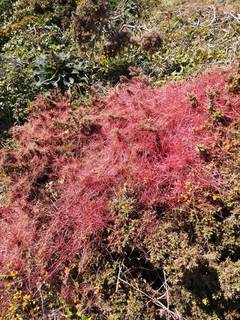
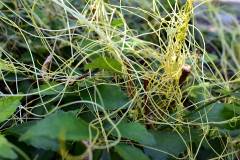
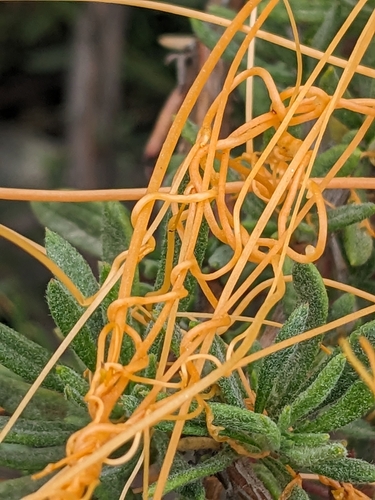
Cuscuta californica is a parasitic annual vine in the morning-glory family, made up of slender, leafless, yellow to orange thread-like stems that twine over and through other plants. It has no functional roots or leaves once established and almost no chlorophyll, so it cannot feed itself; instead it pierces the stems of host plants with small suckers called haustoria and draws water and nutrients directly from them. A seedling germinates in soil, sends up a thin stem that circles until it touches a host, attaches, and then loses its connection to the ground. In summer it produces dense clusters of tiny white to cream bell-shaped flowers about 0.1 inch (2-3 mm) across, followed by small capsules of seed. Heavy infestations form tangled orange mats that can weaken or kill host plants and reduce flowering. It parasitizes a wide range of native shrubs and herbs, especially in chaparral and coastal scrub, and grows in California and the western United States. Because it spreads by seed and by stem fragments, it is hard to remove once it takes hold. It grows wherever suitable hosts and full sun occur, and dies back with its hosts at season end.
Native Range
Native to California and the western United States, extending into adjacent regions, where it grows as a stem parasite on native shrubs and herbs in chaparral, coastal sage scrub, grasslands, and disturbed open ground.Suggested Uses
This species is not grown ornamentally and has no garden use; it is a parasitic weed of wild and cultivated plants. It appears in natural areas and disturbed ground on its host plants. Information on it is mainly for identification and management rather than planting.How to Identify
Appearance
Size & Dimensions
Height1' - 6'
Width/Spread1' - 3'
Bloom Information
Flowers in summer, roughly June to September, producing dense clusters of minute white to cream flowers along the parasitic stems. Flowering is followed by small seed capsules. The plant completes its cycle within a single growing season.
Growing Conditions
Sun Requirements
Requires 6-12 hours of direct sunlight daily
• Full Sun: 6+ hours of direct sunlight
• Partial Shade: 3-6 hours of direct sunlight
• Full Shade: Less than 3 hours of direct sunlight
Water & Climate
Water Needs