Cuscuta, Genus, spp., Multiple species,
- Genus
- Multiple species
dodders
Worldwide, mainly warm temperate Americas
Overview
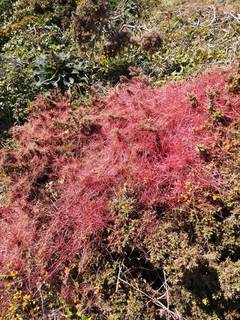
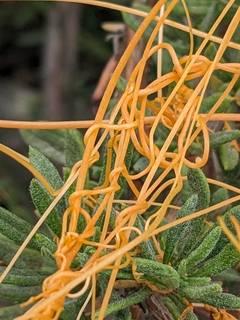
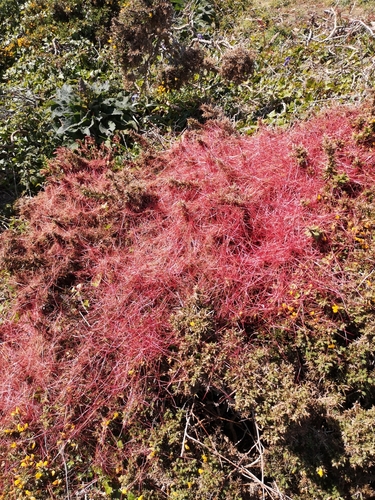
Cuscuta is a genus of roughly 100 to 200 species of parasitic plants in the morning-glory family (Convolvulaceae), found on every inhabited continent. The plants consist of slender, twining, thread-like stems in yellow, orange, or red, almost wholly without leaves, which are reduced to tiny scales, and with little or no chlorophyll. After a seedling germinates and makes brief contact with the ground, it attaches to a host plant and forms peg-like organs called haustoria that penetrate the host stem to draw water and nutrients; the dodder's own root then dies, leaving it entirely dependent on the host. The stems wind and branch over their hosts in dense, tangled mats, producing clusters of small white, cream, pink, or yellow bell- or cup-shaped flowers 0.1-0.2 inch (2-5 mm) across through summer and autumn. Seeds are produced in large numbers and can remain viable in soil for years. Many species are serious agricultural weeds of alfalfa, clover, flax, and other crops, and some are regulated to limit their spread. The common names dodder, strangleweed, and witch's hair describe the twining, smothering growth. The genus has no soil roots and no functional leaves once established.
Native Range
Cuscuta species occur worldwide, with the greatest diversity in warm temperate and subtropical regions of the Americas. Various species are native across North and South America, Europe, Asia, and Africa, and several have spread far beyond their original ranges through contaminated crop seed.Suggested Uses
Cuscuta has no ornamental garden use and is managed as a weed wherever it appears. A few species, such as C. chinensis, are gathered for use in traditional Asian medicine. In natural habitats it acts as a native parasite that can shift the balance among host plant species.How to Identify
Appearance
Size & Dimensions
Height6" - 3'
Width/Spread1' - 5'
Bloom Information
Cuscuta flowers from summer into autumn, generally June to October, producing dense clusters of tiny white to pale yellow or pink flowers along the twining stems. Each plant can set very large quantities of seed over the season. Flowering follows several weeks after the seedling has attached to a host.
Detailed Descriptions
Flower Description
white, cream, pink, or yellowFoliage Description
leafless (scale-like)Growing Conditions
Sun Requirements
Requires 4-12 hours of direct sunlight daily
• Full Sun: 6+ hours of direct sunlight
• Partial Shade: 3-6 hours of direct sunlight
• Full Shade: Less than 3 hours of direct sunlight