Overview
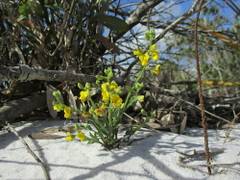
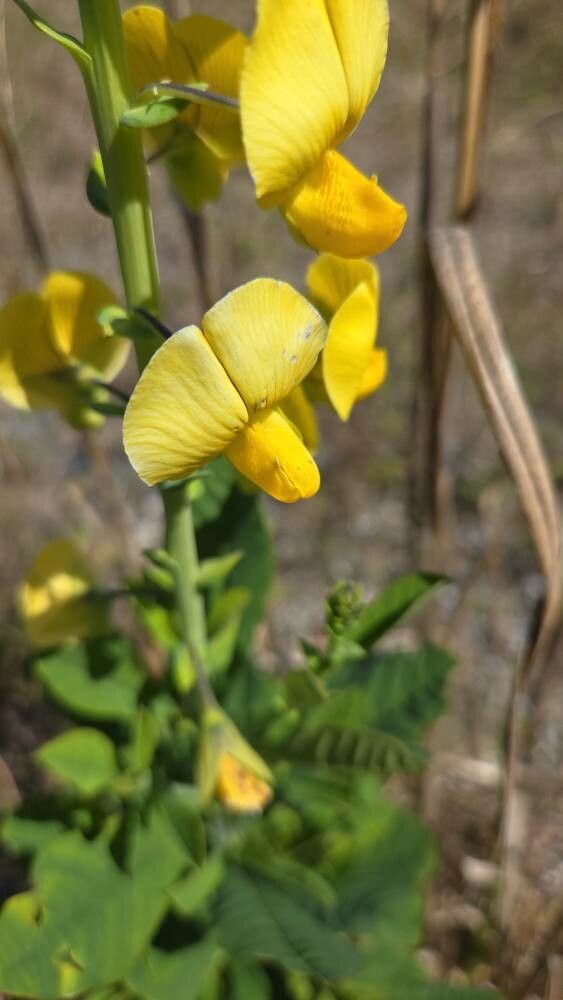
Crotalaria spectabilis is an erect annual legume in the pea family, growing 3-6 feet (0.9-1.8 m) tall and 1-2 feet (30-60 cm) wide on stout, branching stems. The simple, oval to oblong leaves are 2-6 inches (5-15 cm) long, blue-green above and paler beneath. From mid summer into autumn it bears upright terminal racemes 6-16 inches (15-40 cm) long of yellow pea-shaped flowers, each about 0.75-1 inch (2-2.5 cm) long. The flowers give way to inflated, cylindrical pods 1.5-2 inches (4-5 cm) long that turn black and rattle as the loose seeds dry inside, the source of the common name rattlebox. Native to tropical Asia, it was introduced to the southeastern United States as a cover and green-manure crop and has naturalized widely in fields, roadsides, and disturbed ground, where it is now treated as an agricultural weed. All parts, especially the seeds, contain pyrrolizidine alkaloids including monocrotaline, which are toxic to livestock, poultry, and humans and can cause cumulative liver damage. It grows quickly in warm weather and sandy soil, tolerating heat and drought, but it is killed by frost and completes its cycle in one season. It is listed as a noxious or invasive plant in several southeastern states.
Native Range
Crotalaria spectabilis is native to tropical Asia, including the Indian subcontinent and Southeast Asia. It was introduced to North America and has naturalized across the southeastern United States in fields, roadsides, pastures, and other disturbed, sunny ground.Suggested Uses
Crotalaria spectabilis has been grown as a soil-building cover crop and green manure in warm regions, where its nitrogen-fixing roots and fast summer growth suit rough ground. Its toxicity to livestock and weedy spread limit its use in pastures and managed landscapes. It is grown only where its self-sowing can be controlled.How to Identify
Appearance
Size & Dimensions
Height3' - 6'
Width/Spread1' - 2'
Bloom Information
Detailed Descriptions
Foliage Description
Blue-greenGrowing Conditions
Sun Requirements
Requires 6-12 hours of direct sunlight daily
• Full Sun: 6+ hours of direct sunlight
• Partial Shade: 3-6 hours of direct sunlight
• Full Shade: Less than 3 hours of direct sunlight
Water & Climate
Water Needs
Drought Tolerance
Drought tolerant when established
Care & Maintenance
Care Guide
Crotalaria spectabilis grows in full sun in well-drained sandy or loamy soil with a pH from about 5.5 to 7.0. As a warm-season annual it germinates in spring and grows quickly through summer heat, tolerating poor soil and drought once established. It needs no fertilizer because, like other legumes, it fixes nitrogen through root nodules. The plant self-sows freely and can spread into surrounding ground, which has made it an agricultural weed across the warm Southeast. All parts contain pyrrolizidine alkaloids that are toxic if eaten. Frost kills the plant at the end of the season.Pruning
Crotalaria spectabilis needs no pruning as an annual. Removing the seedpods before they ripen limits self-sowing and spread into surrounding ground. Plants are pulled or cut down at the end of the season.Toxicity Warning
Toxic to pets and humansPlanting Guide
Planting Methods & Timing
Planting Method
direct sow
Direct Sow Timing
Spring after the last frost in warm regions
Days to Maturity
90–120 days
Plant Spacing
18 inches