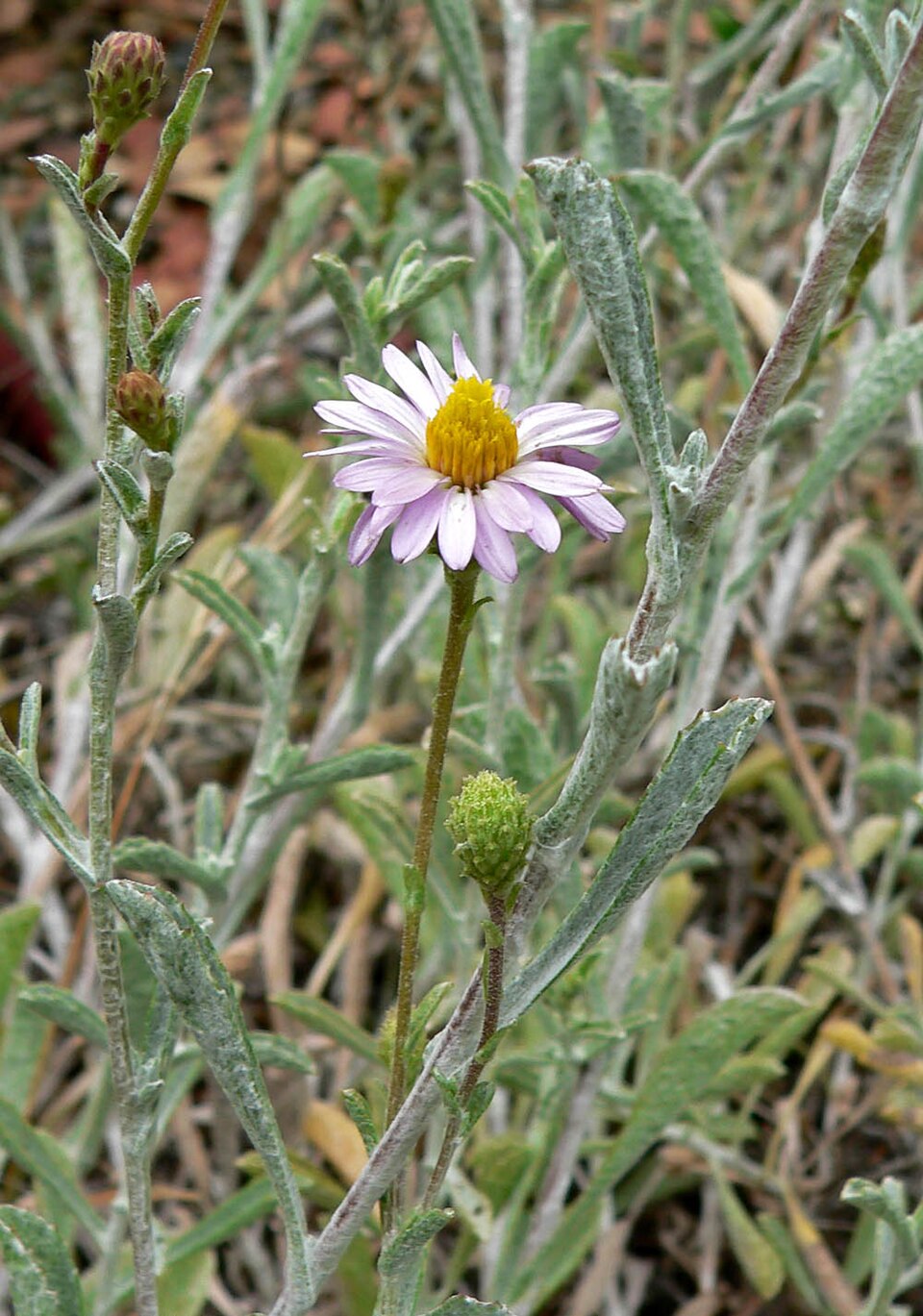
Corethrogyne, Genus, filaginifolia, Species,
- Genus & species
California aster
Overview
Corethrogyne filaginifolia is a perennial or low subshrub in the aster family, forming mounds 12-36 inches (30-90 cm) tall and wide from a woody base. Stems and narrow leaves are covered in gray-white woolly hairs that give the foliage a felted look, and the lower leaves often drop as the flowering stems lengthen. Daisy-like flower heads 0.5-1 inch (13-25 mm) across carry pink to lavender ray florets around a yellow central disk. Flowering runs from summer into fall, extended in coastal sites with cooler air. The plant grows on dry slopes, sandy flats, chaparral, and disturbed ground, tolerating lean soils and extended drought once established. It is variable across its range, with many named forms differing in height and hairiness. In rich or irrigated soil the stems grow lax and the plant is short-lived. The roots are intolerant of waterlogged ground, and winter wet in heavy soil shortens its lifespan. It reseeds where the soil is open and lean.
Native Range
Endemic to California and just into northern Baja California, Mexico. It grows on dry slopes, coastal bluffs, sandy flats, chaparral, and roadsides from sea level to about 5,000 feet (1,500 m).Suggested Uses
Grown in dry gardens, native and pollinator plantings, slopes, and coastal bank stabilization. The late-season flowers draw native bees and butterflies after many other blooms have faded.How to Identify
Appearance
Size & Dimensions
Height1' - 3'
Width/Spread1' - 3'
Colors
Bloom Information
Detailed Descriptions
Foliage Description
gray-greenGrowing Conditions
Sun Requirements
Requires 6-10 hours of direct sunlight daily
• Full Sun: 6+ hours of direct sunlight
• Partial Shade: 3-6 hours of direct sunlight
• Full Shade: Less than 3 hours of direct sunlight
Care & Maintenance
Care Guide
Grows in full sun in sandy, gravelly, or other fast-draining soils of low fertility. Established plants tolerate extended summer drought and need no supplemental water in coastal gardens. Overhead irrigation and rich soil produce floppy growth and shorten the plant''s life. A light cut after flowering keeps the mound compact and can prompt a second flush. It accepts a soil pH from mildly acidic to alkaline and needs no fertilizer. Sharp drainage through winter is the main requirement in heavy-soil gardens.Pruning
Stems cut back by about one-third after the main bloom maintain a dense habit and encourage rebloom. Old woody growth can be thinned in late winter before new shoots emerge.Pruning Schedule
fallwinter
Container Growing
Suitable for container growing
Minimum container size: 3 gallons