Overview
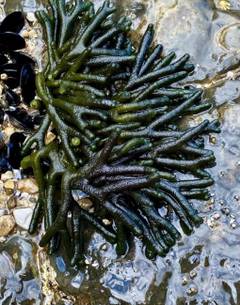
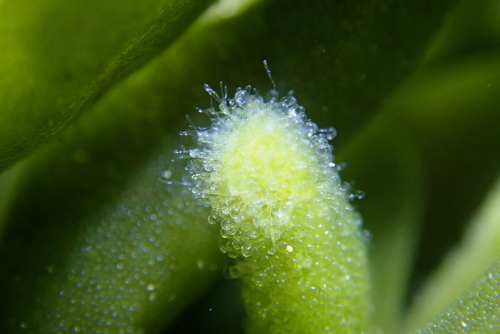
Codium fragile is a marine green alga forming dark green, spongy thalli composed of cylindrical, repeatedly forked branches 0.2-0.4 inch (5-10 mm) in diameter. Individual thalli reach 4-16 inches (10-40 cm) long, anchored to rock, shell, or other algae by a basal spongy disc. The branch surface feels velvety to felted due to a dense layer of microscopic utricles. The thallus is siphonous, built from a single continuous multinucleate cell without internal cross-walls. Colour ranges from medium to dark green, sometimes bleaching paler in strong light or low nutrients. The species occupies intertidal pools and shallow subtidal zones to about 60 feet (18 m) depth on temperate and cool coasts. The subspecies C. fragile ssp. fragile has spread widely outside its native range and grows on hard substrates, mussel beds, and oyster shells, where it can reach high cover. Growth is fastest in summer water temperatures of 50-68F (10-20C). One limitation in cultivation is its tendency to detach during winter storms, leaving only the basal disc to regenerate the following season.
Native Range
Codium fragile is native to the temperate northwestern Pacific along the coasts of Japan, Korea, and eastern China. The widely distributed subspecies C. fragile ssp. fragile has become established on Atlantic and Pacific coasts of North America, in Europe, Australia, and New Zealand.Suggested Uses
Harvested as an edible sea vegetable in Korea and Japan, where it is known as cheonggak and used in side dishes and kimchi. It is also collected as a source of polysaccharides for food and cosmetic use, and is studied in coastal aquaculture alongside shellfish.How to Identify
Appearance
Size & Dimensions
Height4" - 1'4"
Colors
Foliage Colors
Detailed Descriptions
Foliage Description
dark greenGrowing Conditions
Water & Climate
Water Needs