Overview
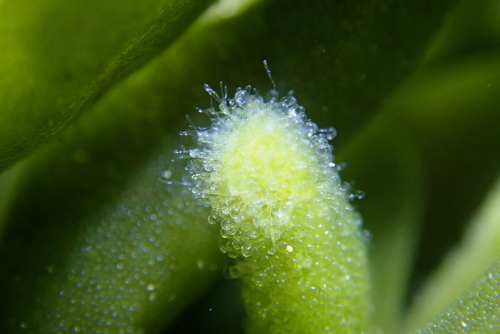
Codium is a genus of green seaweeds in the family Codiaceae, found on rocky shores and in shallow coastal waters worldwide. The body, or thallus, is dark green and spongy to the touch, built from a felted mass of interwoven filaments without true tissues. Many species grow as repeatedly forking, cylindrical, finger-like branches 0.2-0.6 inch (5-15 mm) thick, forming tufts 4-12 inches (10-30 cm) long, while others form flat cushions or thin crusts. The branching, finger-like species give the common names dead man's fingers and spongeweed. The surface is covered with tightly packed swollen filament tips called utricles, which give the velvety texture. Codium attaches to rock by a disc or spongy holdfast and is coenocytic, meaning the whole thallus is effectively one giant cell with many nuclei and no cross-walls. Some species, especially C. fragile, are aggressive introductions that spread on new coasts and foul shellfish beds and harbours. The genus tolerates a range of light and wave exposure and stores food that lets it regrow after grazing. Fragments can break off and grow into new plants.
Native Range
Codium occurs in temperate and tropical seas worldwide, on rocky shores, in tide pools, and in shallow subtidal water. Several species are native to the Pacific, while C. fragile ssp. fragile has spread widely as an introduced seaweed on Atlantic and other coasts.Suggested Uses
Some Codium species are eaten in East Asian cuisine and used in coastal aquaculture, and the genus is grown in marine refugia to take up nutrients. It is studied as a model of coenocytic algal structure and as an example of invasive seaweed spread. Detached thalli wash up and add to beach-cast seaweed used as fertiliser.How to Identify
Appearance
Colors
Foliage Colors
Bloom Information
Codium does not flower. It reproduces by swimming gametes released from the swollen filament tips, and spreads readily by fragmentation, with broken pieces growing into new thalli. Reproduction and growth are strongest in the warmer months in temperate seas.
Growing Conditions
Water & Climate
Water Needs