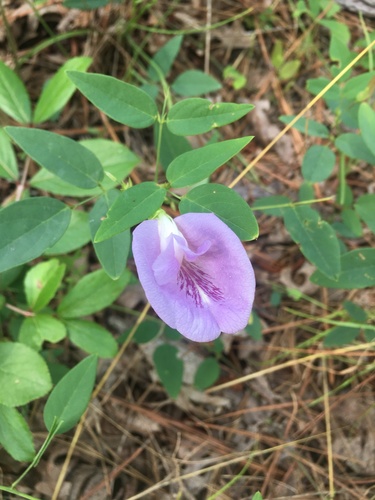
Clitoria, Genus, mariana, Species,
- Genus & species
pigeonwings
Eastern and south-central United States
Overview
Clitoria mariana is a herbaceous perennial legume in the Fabaceae, producing slender twining or trailing stems 1-3 ft (30-90 cm) long from a deep, woody rootstock. The leaves are pinnately trifoliate, with three oval to lance-shaped leaflets each 1-2.5 in (2.5-6 cm) long. In summer it bears pale lavender to blue pea-type flowers 1.5-2 in (4-5 cm) long, held with the large banner petal lowermost because the flower is resupinate, or twisted half a turn. Each flower lasts a day or two, and bloom continues over several weeks. Flat pods 1.5-2 in (4-5 cm) long follow and split to release several seeds. Clitoria mariana grows in dry, sandy, or rocky open woods, glades, and roadsides across the eastern and south-central United States. As a legume it fixes nitrogen through root nodules and tolerates poor, infertile soils, though it grows poorly in wet ground and heavy clay. The stems are too weak to climb tall supports and instead scramble over low vegetation or trail on the ground. Bumblebees and other long-tongued bees pull the keel down to reach nectar and effect pollination, and the foliage serves as larval food for several skipper butterflies.
Native Range
Native to the eastern and south-central United States, from New York and the mid-Atlantic south to Florida and west to Texas and Kansas. It grows in dry open woodlands, sandy glades, pine flatwoods, and roadside banks.Suggested Uses
Used in native plant gardens, dry meadows, and naturalized woodland edges where it can scramble over low vegetation. Suited to sandy or rocky banks and pollinator plantings. Combines with warm-season grasses and other drought-tolerant natives.How to Identify
Appearance
Size & Dimensions
Height1' - 3'
Width/Spread1' - 2'
Bloom Information
Blooms from June through September, with scattered flowers opening over the season rather than all at once. Individual flowers last only a day or two. Bloom is heaviest in midsummer and tapers as pods mature.
Detailed Descriptions
Foliage Description
greenGrowing Conditions
Sun Requirements
Requires 4-8 hours of direct sunlight daily
• Full Sun: 6+ hours of direct sunlight
• Partial Shade: 3-6 hours of direct sunlight
• Full Shade: Less than 3 hours of direct sunlight
Care & Maintenance
Care Guide
Grows in full sun to part shade in dry, sandy, or rocky soil with sharp drainage. As a nitrogen-fixing legume it tolerates infertile ground and needs no added fertilizer. Soil pH from 5.5 to 7.0 suits it, and it grows poorly in wet or heavy clay soils. Drought is tolerated once the deep root is established. The weak stems scramble over low plants and benefit from neighbors or a short support. Plants are slow to establish from seed and transplant poorly once settled because of the deep taproot.Pruning
Pruning is rarely needed. Stems can be cut back to the ground in late fall or early spring after they die down. Trimming wayward stems in summer keeps the plant within bounds on low supports.Pruning Schedule
early spring