Chimonanthus, Genus, praecox, Species,
- Genus & species
Wintersweet
Overview
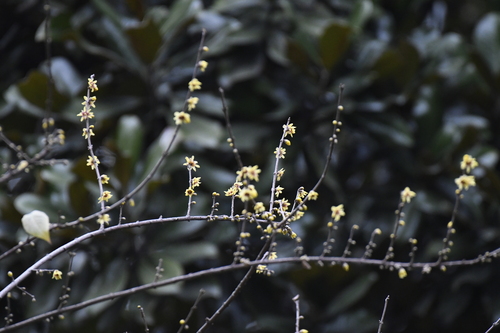
Chimonanthus praecox is a medium to large, upright, multi-stemmed, deciduous shrub reaching 8–15 feet (2.4–4.5 m) tall with a spread of 6–12 feet (1.8–3.6 m). The shrub is grown for its strongly fragrant winter flowers—small, waxy, translucent yellow blooms 0.75–1 inch (2–2.5 cm) across with an inner ring of dark reddish-purple to maroon staminodes, borne directly on bare branches from December through February. The spicy, sweet fragrance carries 15–20 feet (4.5–6 m) from a flowering plant on still days. Leaves are opposite, lanceolate to elliptic, 3–6 inches (8–15 cm) long, medium green, rough-textured. The foliage is not showy; the coarse leaves emerge after flowering. The plant carries a somewhat gaunt, open habit in youth, filling out with age. Bark is gray-brown, smooth. Growth rate is moderate at 8–12 inches (20–30 cm) per year. Slow to establish and slow to begin flowering—seedling plants may take 5–7 years to bloom. Grafted plants flower sooner, often within 2–3 years of planting. No serious pest or disease problems. The coarse summer foliage and open winter habit limit the shrub's role as a year-round ornamental; it is primarily a winter-fragrance specialist.
Native Range
Chimonanthus praecox is native to China (Hubei, Sichuan, Zhejiang, and neighboring provinces), occurring in mountain woodlands and shrubby slopes from 1,500 to 6,500 feet (450–2,000 m). It has been cultivated in Chinese and Japanese gardens for centuries.Suggested Uses
Planted near entries, paths, windows, and seating areas at 6–10 foot (1.8–3 m) spacing where the winter fragrance reaches people on still days. Functions as a wall-trained shrub on south- or west-facing walls. The December–February bloom period carries fragrance when few other plants are in flower in zones 7–9. Sited near frequently used doorways, the spicy scent registers each time the door is opened. The coarse summer habit limits its role as a standalone specimen; planting with summer-interest companions in front screens the foliage. Containers and exposed, cold, windy sites are unsuitable.How to Identify
Appearance
Size & Dimensions
Height8' - 15'
Width/Spread6' - 12'
Bloom Information
Small, waxy, translucent yellow flowers 0.75–1 inch (2–2.5 cm) across with dark reddish-purple inner staminodes open on bare branches from December through February. Bloom duration is 6–8 weeks, dependent on winter temperatures; warmer winters compress the bloom into 4–5 weeks. Individual flowers tolerate temperatures down to approximately 20°F (−7°C); hard freezes damage open flowers but not buds, so the shrub continues to flower as new buds open after a freeze.
Detailed Descriptions
Flower Description
Translucent yellow with dark reddish-purple inner staminodesFoliage Description
Medium green, lanceolate, rough-texturedGrowing Conditions
Sun Requirements
Requires 4-10 hours of direct sunlight daily
• Full Sun: 6+ hours of direct sunlight
• Partial Shade: 3-6 hours of direct sunlight
• Full Shade: Less than 3 hours of direct sunlight
Care & Maintenance
Care Guide
Plant in full sun to partial shade in average, well-drained soil. Full sun against a south- or west-facing wall produces the warmest microclimate and earliest bloom; the wall radiates heat that extends the fragrance and shelters the flowers. Cold, drying north and east winds damage open flowers and kill flower buds, so siting in lee of structures or evergreen plantings extends the bloom season. Consistent moisture during establishment (first 2–3 years). Slow to begin flowering: seedling plants may take 5–7 years; grafted plants flower within 2–3 years of planting. The coarse summer foliage can be screened by interplanting summer-interest companions in front. No serious pest or disease problems.Pruning
Prune immediately after flowering in late February to March. The oldest one-third of stems are removed at the base every 2–3 years to renew the framework. Flowered side branches are shortened to 2–3 buds. The shrub trains flat against a wall in espalier form. Pruning in summer or fall removes developing flower buds and sacrifices the next winter's bloom.Pruning Schedule
Prune: February–March
winterearly spring