Chenopodium, Genus, album, Species,
- Genus & species
lambsquarters
Europe, Asia; possibly also native to parts of North America
SunFull Sun – Part Shade
Overview
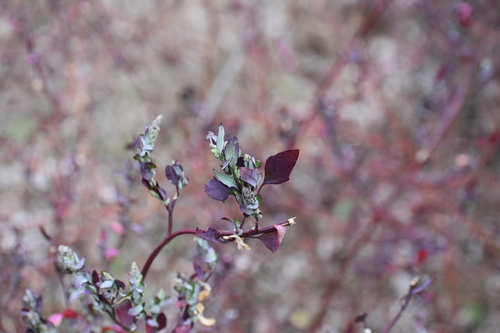
Chenopodium album is an erect summer annual in the family Amaranthaceae reaching 12-60 inches (30-150 cm) tall with a 12-24 inch (30-60 cm) spread. Stems are erect, branching, grooved, and often streaked with red or purple. Leaves are alternate, rhombic to triangular, 1-3 inches (2.5-8 cm) long, with irregularly toothed to shallowly lobed margins. Young leaves and growing tips carry a characteristic white mealy (farinose) coating of vesicular trichomes that rubs off when touched, a diagnostic feature of the species. Lower leaves are broader and more lobed; upper leaves are narrower, lance-shaped, and often entire. Flowers are small, green, and inconspicuous, densely packed in granular clusters on terminal and axillary panicles. Each plant produces 20,000-70,000 seeds; large plants in fertile soil can produce up to 500,000 seeds. Seeds are round, glossy black, 0.04-0.06 inch (1-1.5 mm) in diameter, and remain viable in soil for 20-40 years. Foliage accumulates nitrates and oxalates, particularly in nitrogen-rich soils, causing toxicity in livestock when consumed in large quantities. C. album ranks among the more widespread agricultural weeds globally, recorded on every continent except Antarctica.
Native Range
Chenopodium album has an uncertain native range due to its ancient association with human agriculture. Populations are considered native to Europe and Asia, with some possibly native to parts of North America. The species is naturalized on every continent except Antarctica, occurring from sea level to over 12,000 feet (3,600 m) elevation, and is found in cultivated fields, gardens, waste ground, and nutrient-rich disturbed sites.Suggested Uses
Used in weed identification courses for teaching Amaranthaceae morphology and farinose leaf characters. Young leaves and shoot tips are edible when cooked (high in oxalates when raw) and are consumed as potherbs in many cultures. Seeds are consumed by ground-feeding birds including sparrows and quail. Studied in agricultural weed science as a model for seed bank longevity and herbicide resistance evolution.How to Identify
Appearance
Size & Dimensions
Height1' - 5'
Width/Spread1' - 2'
Bloom Information
Flowers appear June through October, triggered by shortening day length. Individual panicles bloom over 2-3 weeks. Flowering and seed production continue until the first killing frost. Seeds begin maturing 3 weeks after pollination. The species is wind-pollinated; pollen is a common late-summer allergen.
Detailed Descriptions
Flower Description
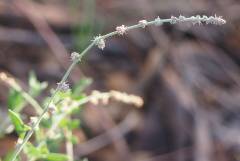
Green, small, inconspicuous, densely packed in granular clusters on terminal and axillary paniclesFoliage Description
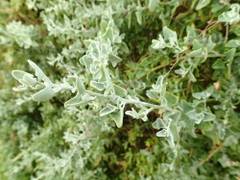
Gray-green to blue-green above with a white mealy (farinose) coating, especially on young leaves and growing tips; rhombic to triangular with irregularly toothed marginsGrowing Conditions
Sun Requirements
Requires 6-12 hours of direct sunlight daily
• Full Sun: 6+ hours of direct sunlight
• Partial Shade: 3-6 hours of direct sunlight
• Full Shade: Less than 3 hours of direct sunlight