Chasmanthium, Genus, laxum, Species,
- Genus & species
slender woodoats
Southeastern United States from southern New Jersey and Maryland south to Florida and west to eastern Texas
Overview
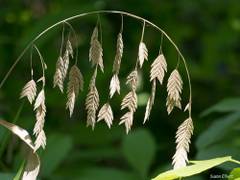
Chasmanthium laxum is a clumping native woodland grass of the southeastern United States, growing 24–36 inches (60–90 cm) tall and 18–24 inches (45–60 cm) wide. The species epithet 'laxum' translates as 'loose' or 'lax' and refers to the open, airy panicle structure. From mid-July through late September the plant carries small dangling flat spikelets 0.25–0.5 inch (6–13 mm) long on slender arching stems, each spikelet a miniature compressed oat-shape that ages from green to bronze-tan and persists into autumn. Foliage is composed of medium green narrow lance-shaped leaves 4–6 inches (10–15 cm) long and 0.25–0.4 inch (6–10 mm) wide, arranged at intervals along upright bamboo-like stems; the leaf-along-stem habit separates the genus from tussock-forming grasses. Self-sowing is light: seedling counts run 10–30 per established clump per season and seedlings are easy to lift, in contrast to the related C. latifolium which produces several hundred seedlings per clump and can colonize a planting bed within 2–3 seasons. The lighter self-sowing rate of C. laxum stems from the smaller seed crop and the partial-shade habitat preference. Cultural needs: partial to full shade with 2–5 hours of filtered light, moist humus-rich soil, and zone 5 hardiness. Stems brown after frost and remain standing through winter. Deer rarely browse the foliage.
Native Range
Chasmanthium laxum is native to the southeastern United States, with a range from southern New Jersey and Maryland south to Florida and west to eastern Texas, where it grows in moist deciduous woodlands, along stream banks, and in the partial shade of pine flatwoods.Suggested Uses
Used in moist shade gardens, woodland-edge plantings, native shade-bed mixes, and along the cool side of buildings. Combines with Tiarella cordifolia, Heuchera villosa, and ferns such as Athyrium filix-femina for a layered native shade planting. Where heavy self-sowing of C. latifolium is a concern, C. laxum is the lower-volunteering option in the same genus.How to Identify
Appearance
Size & Dimensions
Height2' - 3'
Width/Spread1'6" - 2'
Colors
Bloom Information
Detailed Descriptions
Flower Description
Small dangling flat spikelets 0.25-0.5 inch (6-13 mm) long opening green and aging to bronze-tan, carried on slender arching stemsFoliage Description
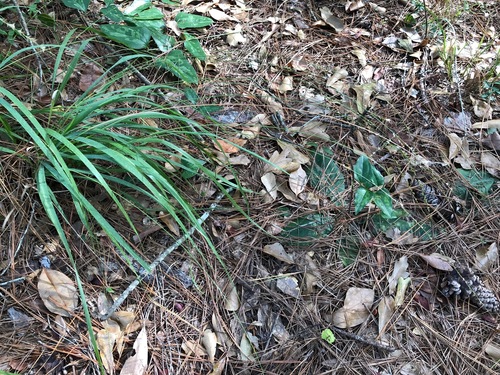
Medium green narrow lance-shaped leaves 4-6 inches (10-15 cm) long arranged at intervals along upright bamboo-like stemsGrowing Conditions
Sun Requirements
Requires 2-5 hours of direct sunlight daily
• Full Sun: 6+ hours of direct sunlight
• Partial Shade: 3-6 hours of direct sunlight
• Full Shade: Less than 3 hours of direct sunlight
Care & Maintenance
Care Guide
Plant in partial to full shade with 2–5 hours of filtered or dappled light; the stems lean toward light and bloom drops in deep shade. Soil should be moist, humus-rich, and slightly acidic to neutral (pH 5.5–7.5), kept evenly moist throughout the growing season. Mulch 2 inches (5 cm) deep with leaf mold or composted bark to retain moisture. Water during dry spells. Cut all stems to 4 inches (10 cm) above the crown in late February or early March before new growth pushes; leaving stems standing through winter holds the seed display for cool-season interest. Lift unwanted self-sown seedlings in spring while the soil is moist; volunteer counts run 10–30 per clump per season.Pruning
Cut all stems to 4 inches (10 cm) above the crown in late February or early March before new growth pushes. Skip pruning during the growing season; the persisting seed-head display is the autumn and winter feature. Lift and divide every 5–6 years if the clump's center thins.Pruning Schedule
Prune: February–March
early spring
Container Growing
Suitable for container growing
Minimum container size: 5 gallons