Chasmanthium, Genus, latifolium, Species,
- Genus & species
northern sea oats
Eastern North America, from New Jersey south to Florida and west to Texas and Michigan
Overview
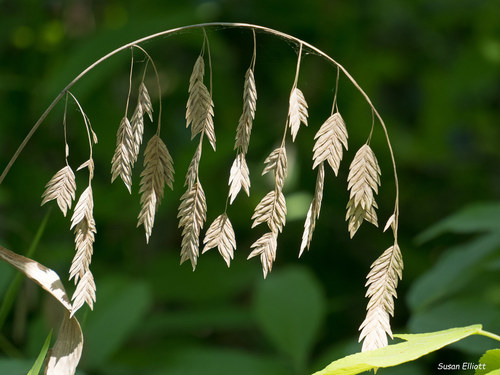
Chasmanthium latifolium is a clump-forming native grass in the grass family (Poaceae) that grows 24-48 inches (60-120 cm) tall and 18-24 inches (45-60 cm) wide. The primary ornamental feature is the flat, oat-like spikelets that dangle on thread-thin pedicels from arching stems, swaying in the slightest breeze. Spikelets emerge green in midsummer and age to copper-bronze through fall, persisting through winter when they catch frost and snow. The broad, bamboo-like leaf blades are 0.5-0.75 inch (1.3-2 cm) wide, much wider than most ornamental grasses, giving the plant a lush, tropical appearance in shade. The foliage turns copper to bronze in fall. The species is among the few ornamental grasses that thrive in shade, performing in sites with as little as 2 hours of direct light. In full sun, the foliage stays shorter and denser; in shade, stems elongate and arch more dramatically. Self-sowing is the primary maintenance concern: the species produces abundant seed, and in moist, open ground, seedlings can appear prolifically within a few feet of the parent plant. Removing seed heads before they shatter in late fall reduces volunteer numbers. In dry, lean soil, self-sowing is less aggressive. The species naturally grows along stream margins and in bottomland forests where periodic flooding occurs. Deer avoid the foliage.
Native Range
Chasmanthium latifolium is native to eastern North America, from New Jersey and Michigan south to Florida and west to Texas. It grows in moist bottomland forests, stream margins, and floodplains, often in partial to full shade.Suggested Uses
Used in shade gardens, woodland edges, and along stream margins where the arching seed heads add motion and texture. The shade tolerance makes this a versatile ornamental grass for forest understory planting. Works as a specimen or in groups of 3-5. Container culture works in pots of 7 gallons (26 liters) or more. The dried seed heads are valued in floral arrangements.How to Identify
Appearance
Size & Dimensions
Height2' - 4'
Width/Spread1'6" - 2'
Bloom Information
Spikelets emerge in July and persist through winter, giving a display period of 12+ weeks in the growing season and extending through the dormant months. Green spikelets age to copper-bronze by September. The dangling spikelets move in air currents, adding kinetic interest. Seed dispersal occurs in late fall to early winter.
Detailed Descriptions
Flower Description
Green aging to copper-bronze, flat dangling spikeletsFoliage Description
Medium green, broad, bamboo-likeGrowing Conditions
Sun Requirements
Requires 2-10 hours of direct sunlight daily
• Full Sun: 6+ hours of direct sunlight
• Partial Shade: 3-6 hours of direct sunlight
• Full Shade: Less than 3 hours of direct sunlight
Care & Maintenance
Care Guide
Plant in partial shade to full sun (or full shade) with 2-10 hours of light. Average to moist soil of any type is acceptable. Watering during establishment supports growth; the species is drought-tolerant once rooted, though the fullest growth occurs in moist conditions. The primary maintenance task is managing self-sowing: seed heads are removed in late fall before they shatter when volunteer seedlings are unwanted, or naturalisation is allowed in large-scale plantings. All growth is cut to 3-4 inches (8-10 cm) above ground in late February or March before new growth. No fertilisation is needed.Pruning
Seed heads and foliage are left standing through winter for visual interest. All growth is cut to 3-4 inches (8-10 cm) above ground in late winter before new growth. Seed heads are removed in late fall when self-sowing control is needed.Pruning Schedule
Prune: February–March
early spring
Container Growing
Suitable for container growing
Minimum container size: 7 gallons