Overview
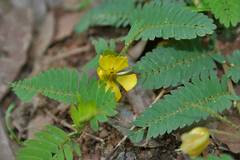
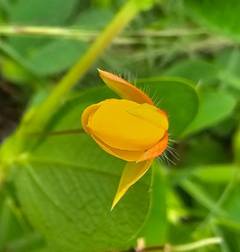
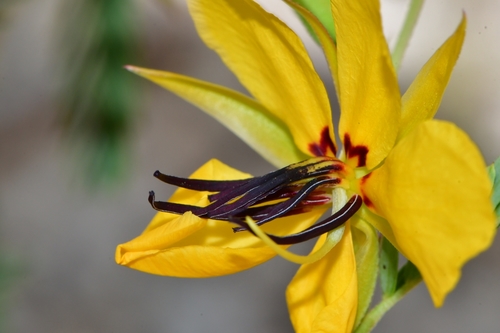
Chamaecrista fasciculata is an upright annual legume in the pea family, growing 1-3 feet (30-90 cm) tall on slender, branching stems. The leaves are pinnately compound with 8-18 pairs of small oblong leaflets that fold together when touched or at night. From midsummer into fall the plant produces yellow flowers about 1-1.5 inches (2.5-4 cm) across, each with five unequal petals and a small red spot at the base, borne in the leaf axils along the stem. Small cup-shaped glands at the leaf bases secrete nectar that draws ants, while the flowers are worked by bumblebees and other native bees. Flat pods 1.5-2.5 inches (4-6 cm) long follow the flowers and twist open to fling out the seeds. As a legume it fixes nitrogen through root bacteria and grows strongly on poor, sandy soil. Chamaecrista fasciculata self-seeds freely and reappears each year from seed, often forming colonies on disturbed ground. The seeds feed quail, songbirds, and small mammals through fall and winter.
Native Range
Chamaecrista fasciculata is native to central and eastern North America, from the Great Plains and Midwest east to the Atlantic coast and south into Mexico. It grows in prairies, open woods, roadsides, and sandy disturbed ground.Suggested Uses
Grown in pollinator gardens, prairie and meadow plantings, erosion-control seedings, and roadside restorations on poor soil. It supplies nectar and pollen to native bees, hosts the larvae of several sulphur butterflies, and feeds seed-eating birds. Its nitrogen fixation and tolerance of sandy ground suit it to reclaiming bare or eroded sites.How to Identify
Appearance
Size & Dimensions
Height1' - 3'
Width/Spread1' - 2'
Bloom Information
Detailed Descriptions
Flower Description
yellow with a red centerFoliage Description
greenGrowing Conditions
Sun Requirements
Requires 6-12 hours of direct sunlight daily
• Full Sun: 6+ hours of direct sunlight
• Partial Shade: 3-6 hours of direct sunlight
• Full Shade: Less than 3 hours of direct sunlight
Water & Climate
Water Needs
Drought Tolerance
Drought tolerant when established
Care & Maintenance
Care Guide
Grow from seed sown in full sun on well-drained, sandy, or poor soil, where this legume grows strongly without added fertilizer. Established stands are drought tolerant and need no watering in most seasons. Rich soil and shade produce leggy growth and fewer flowers. As an annual it completes its cycle in one season and returns from self-sown seed, so a patch persists year to year if some seed is left to drop. Scarified or scuffed seed germinates more evenly. The plant fixes its own nitrogen and builds up thin soils over time.Pruning
No pruning is required for this annual. Plants can be sheared back lightly in midsummer to curb legginess and prompt branching. Stems are left standing into fall so the pods can ripen and drop seed for the next year.Toxicity: Not assessed
UnknownPlanting Guide
Planting Methods & Timing
Planting Method
direct sow
Direct Sow Timing
early spring after last frost
Days to Maturity
60–90 days
Plant Spacing
12 inches
Companion Planting
Good Companions