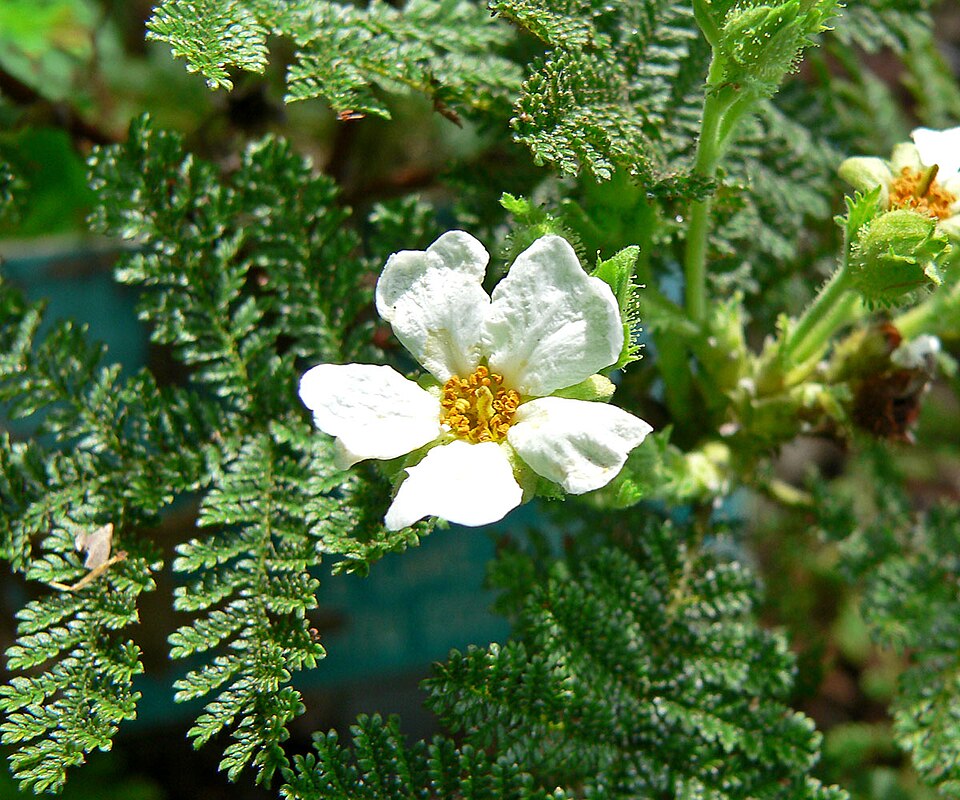
Chamaebatia, Genus, spp., Multiple species,
- Genus
- Multiple species
mountain misery
California and northern Baja California
Overview
Chamaebatia is a genus of two species of low, evergreen, aromatic shrubs in the rose family, Rosaceae, native to California and northern Baja California. C. foliolosa, mountain misery or bearclover, is the widespread species, forming spreading mats 8 to 24 inches (20 to 60 cm) tall that root as they creep and can cover large areas of forest floor. The fern-like leaves are finely divided into many small segments, dark green, and coated with sticky, resinous glands that release a strong, pungent scent, especially in heat, which gives the plant its common name. White, five-petalled flowers about 0.5 to 0.75 inch (1.5 to 2 cm) across, resembling small strawberry flowers with yellow stamens, appear in loose clusters in late spring and early summer. Small dry single-seeded fruits follow. The plant spreads aggressively by rhizomes beneath pine and mixed-conifer forest, holding soil on slopes but resprouting quickly after fire and resisting removal. The resinous foliage is flammable. Deep roots let it endure summer drought under open forest canopy.
Native Range
Chamaebatia is native to California and northern Baja California, Mexico. C. foliolosa grows on the western slopes of the Sierra Nevada and in the foothills under ponderosa and mixed-conifer forest, while C. australis occurs in southern California and Baja.Suggested Uses
Used in native and habitat plantings, erosion control on forest slopes, and large naturalistic gardens within its range. It binds soil and forms an evergreen groundcover under pines. Its flammability and spreading habit limit its use near buildings.How to Identify
Appearance
Size & Dimensions
Height8" - 2'
Width/Spread3' - 8'
Bloom Information
Detailed Descriptions
Flower Description
white with yellow stamensFoliage Description
dark greenGrowing Conditions
Sun Requirements
Requires 4-8 hours of direct sunlight daily
• Full Sun: 6+ hours of direct sunlight
• Partial Shade: 3-6 hours of direct sunlight
• Full Shade: Less than 3 hours of direct sunlight
Care & Maintenance
Care Guide
Mountain misery grows in full sun to part shade under open conifer canopy, in well-drained, rocky or sandy, low-fertility soils that are slightly acidic, around pH 5.5 to 6.5. It tolerates summer drought once its deep roots establish and needs no irrigation in its native climate. It spreads strongly by rhizomes, so it is given room and is hard to confine in small gardens. The resinous foliage is flammable, a point against setting it close to structures in fire-prone areas. It is seldom offered in the trade and is difficult to transplant from the wild. Established stands need little care.Pruning
Little pruning is needed. Stands can be mown or cut back to keep them low and reduce fuel load, and they resprout vigorously from rhizomes afterward. Removal is difficult because severed rhizomes regrow.Pruning Schedule
Prune: July
summer
