Chaetopappa, Genus, ericoides, Species,
- Genus & species
rose heath
Western and central United States and northern Mexico
Overview
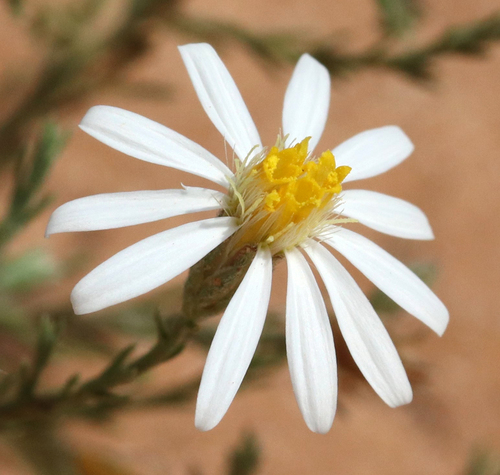
Chaetopappa ericoides is a low, mat-forming perennial of dry open ground in the western and central United States and Mexico, spreading by slender rhizomes into cushions 2-8 inches (5-20 cm) tall. The wiry, much-branched stems are crowded with tiny narrow heath-like leaves 0.1-0.3 inch (3-8 mm) long that give the plant its rose heath name. From spring into autumn the stem tips carry small daisy-like flower heads about 0.5 inch (12 mm) across, each with 12-24 white to faintly pink ray florets around a yellow center. The plant blooms over a long season when moisture allows, opening fresh heads after rains. C. ericoides grows on dry plains, rocky slopes, and open grasslands in sandy, gravelly, or limestone soils, in full sun. Its deep root system and spreading rhizomes let it withstand drought and form patches over time. The small stature and tiny leaves give a sparse texture, and the flower heads close in dull weather, so the display depends on sun. It can spread beyond its intended space on open ground.
Native Range
Chaetopappa ericoides is native to the western and central United States and northern Mexico, from the Great Plains and Rocky Mountains south into Texas and the desert Southwest. It grows on dry plains, rocky slopes, and open grasslands in sandy, gravelly, or limestone soils.Suggested Uses
C. ericoides is used in rock gardens, gravel plantings, dry borders, and native and pollinator plantings where its low mats carry small daisies over a long season. It suits xeriscapes and the front edges of dry beds. Its spreading habit makes it suited to naturalistic plantings where it has room to fill in.How to Identify
Appearance
Size & Dimensions
Height2" - 8"
Width/Spread8" - 1'
Bloom Information
C. ericoides flowers over a long season from spring into autumn, roughly April through October, opening fresh heads after rains. The white to pale pink daisy heads close in cloudy weather and on overcast days. Bees and small insects visit the flowers, which set wind-dispersed seed through the season.
Detailed Descriptions
Flower Description
White to pale pinkFoliage Description
GreenGrowing Conditions
Sun Requirements
Requires 6-12 hours of direct sunlight daily
• Full Sun: 6+ hours of direct sunlight
• Partial Shade: 3-6 hours of direct sunlight
• Full Shade: Less than 3 hours of direct sunlight
Care & Maintenance
Care Guide
C. ericoides grows in full sun on dry, sharply drained sandy, gravelly, or limestone soil with a neutral to alkaline pH of 6.5-8.0. It withstands heat, drought, and lean soils once established, drawing on a deep root system. Excess water and rich soil cause loose, weak growth. It spreads by rhizomes into low patches and self-sows on open ground. Little water is needed beyond establishment, and no fertilizer is required. Pests and diseases are rare in dry, open sites.Pruning
C. ericoides needs little pruning. A light shearing after the main flush tidies the mat and can prompt fresh bloom. Spreading rhizomes can be trimmed to keep the patch within bounds.Container Growing
Suitable for container growing
Minimum container size: 1 gallons