1 / 3
© 羅恩至, some rights reserved (CC-BY-NC) · iNaturalist
Cephalotaxus harringtonia
Japanese Plum Yew
Japan (Honshu, Shikoku, Kyushu) and Korea
Learn more
Overview
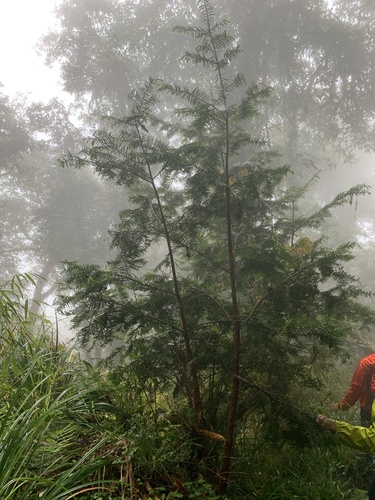
Cephalotaxus harringtonia is a slow-growing, spreading to upright, evergreen coniferous shrub or small tree reaching 5–10 feet (1.5–3 m) tall with a spread of 5–10 feet (1.5–3 m) in cultivation, though it can reach 20–30 feet (6–9 m) in its native habitat. The plant is valued for its shade tolerance—one of the few conifers that thrives in deep shade. Needles are flat, linear, 1–2.5 inches (2.5–6 cm) long, dark green and glossy above with two pale silvery-white stomatal bands beneath, arranged in a distinctive V-shaped (pectinate) pattern along the stems. The needles resemble those of Taxus (yew) but are longer, wider, and more leathery. The form is variable: upright selections grow as columnar small trees, while spreading forms create wide, layered shrubs. Female plants produce olive-like, fleshy, green to purple-brown drupes 1–1.25 inches (2.5–3 cm) long—larger and more elongated than yew arils. Growth rate is slow at 4–8 inches (10–20 cm) per year. Tolerates heavy shade, deer browsing is not a concern (deer-resistant), and the plant is not toxic—unlike Taxus, which is highly poisonous. The combination of shade tolerance, deer resistance, and non-toxicity makes this a functional alternative to yew.
Native Range
Cephalotaxus harringtonia is native to Japan (Honshu, Shikoku, Kyushu) and Korea. It occurs as an understory shrub or small tree in moist, shaded broadleaf and mixed forests from lowland to montane elevations.Suggested Uses
Planted as a shade-tolerant foundation shrub, hedge, or specimen at 4–6 foot (1.2–1.8 m) spacing. Functions as a deer-resistant, non-toxic alternative to Taxus in shaded landscapes. The shade tolerance makes it suitable for north-facing foundations, under trees, and in woodland gardens. Formal hedges and screens in shade. Grows in containers of at least 7 gallons (26 L). The columnar forms ('Fastigiata') serve as vertical accents in shade.How to Identify
Appearance
Size & Dimensions
Height5' - 10'
Width/Spread5' - 10'
Reaches mature size in approximately 15 years
Bloom Information
Male strobili are small, round, clustered along the undersides of stems in March–April. Female cones are inconspicuous. Fleshy, olive-like drupes 1–1.25 inches (2.5–3 cm) long ripen from green to purple-brown in late summer to fall on female plants. Dioecious: separate male and female plants required for fruit production.Detailed Descriptions
Foliage Description
Dark green and glossy above with silvery-white stomatal bands beneathGrowing Conditions
Sun Requirements
Requires 1-6 hours of direct sunlight daily
• Full Sun: 6+ hours of direct sunlight
• Partial Shade: 3-6 hours of direct sunlight
• Full Shade: Less than 3 hours of direct sunlight
Care & Maintenance
Care Guide
Plant in moist, well-drained, humus-rich, acidic to neutral soil in partial to full shade. One of the few conifers thriving in deep shade. Protect from hot afternoon sun and drying winter winds. Consistent moisture is beneficial. Tolerates pruning well and can be maintained at smaller sizes. Slow growth means the plant takes many years to reach mature size. No serious pest or disease problems. Deer do not browse the foliage.Pruning
Prune in late spring after new growth emerges. Tolerates moderate to heavy pruning and can be maintained as a formal hedge or shaped specimen. Cut back to side branches; the plant regenerates from old wood more readily than Taxus. Spreading forms can be pruned to maintain desired width.Pruning Schedule
J
F
M
A
M
J
J
A
S
O
N
D
late spring
Maintenance Level
very lowContainer Growing
✓ Suitable for container growing
Minimum container size: 7 gallons