Image 1 of 4
1 / 4
© No machine-readable author provided. Rickjpelleg assumed (based on copyright claims)., some rights reserved (CC-BY) · Wikimedia Commons
Casuarina, Genus, spp., Multiple species,
- Genus
- Multiple species
She-oaks
Australia, SE Asia, Pacific islands, eastern Africa
Overview
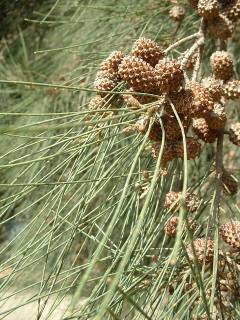
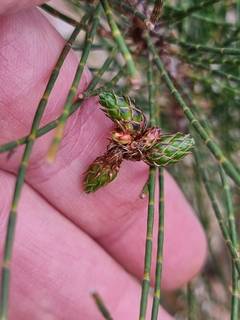
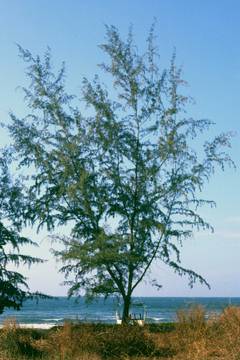
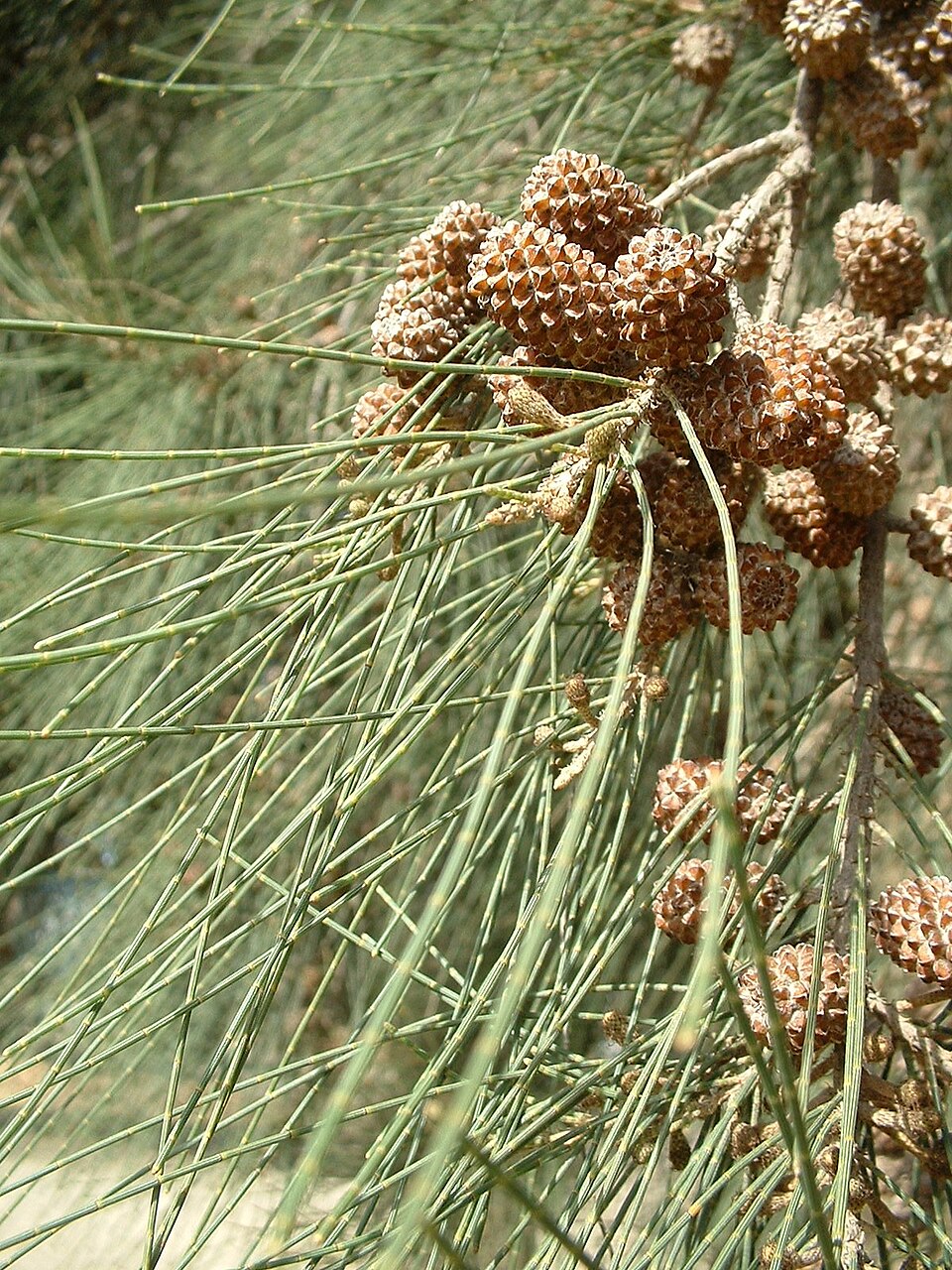
Casuarina is a genus of about 17 evergreen trees and large shrubs in the family Casuarinaceae, native to Australia, Southeast Asia, the Pacific islands, and eastern Africa. The trees reach 16–115 ft (5–35 m) tall and bear long, slender, jointed green branchlets that resemble pine needles and carry out photosynthesis, while the true leaves are reduced to tiny scales arranged in whorls at each joint. This conifer-like appearance gives rise to common names such as she-oak and Australian pine, though Casuarina is a flowering plant, not a conifer. The trees are mostly dioecious, with rusty male flower spikes and small red female heads on separate trees; the woody, cone-like fruiting bodies that follow are 0.4–1 in (1–2.5 cm) long and release winged seeds. Like legumes, Casuarina fixes atmospheric nitrogen through Frankia bacteria in its roots, letting it grow on poor, sandy, and saline soils, and several species tolerate salt spray, wind, and drought. Casuarina grows in full sun in USDA zones 9–11, and some species, planted widely for windbreaks and timber, have become aggressive invaders of coasts and wetlands outside their native range.
Native Range
Casuarina is native to Australia, where most species occur, and extends through Malesia and Southeast Asia to the Pacific islands, with outliers in eastern Africa and the Indian subcontinent. The trees grow on coastal dunes, riverbanks, rocky ridges, and poor sandy flats, often in exposed, saline, or seasonally dry sites.Suggested Uses
Casuarina is planted for windbreaks, shelterbelts, coastal stabilisation, and erosion control on poor and saline soils, and the dense, hard wood is used for fuel and turnery. In large gardens and parks the weeping forms are grown as fast shade and specimen trees. Because some species invade coasts and wetlands, planting is avoided or regulated in parts of Florida, the Caribbean, and other warm regions.How to Identify
Appearance
Size & Dimensions
Height16' - 115'
Width/Spread10' - 30'
Bloom Information
Flowering is inconspicuous and varies by species and climate, often through spring and summer or after rain. Male trees carry small rusty-brown flower spikes at the branchlet tips that shed wind-blown pollen, while female trees bear tiny red flower clusters along the twigs. The fertilised female heads harden into woody, cone-like fruits over the following months.
Detailed Descriptions
Foliage Description
greenGrowing Conditions
Sun Requirements
Requires 6-12 hours of direct sunlight daily
• Full Sun: 6+ hours of direct sunlight
• Partial Shade: 3-6 hours of direct sunlight
• Full Shade: Less than 3 hours of direct sunlight
Care & Maintenance
Care Guide
Casuarina grows in full sun on a wide range of soils, including poor, sandy, and saline ground, helped by nitrogen-fixing Frankia bacteria in its roots. The trees tolerate salt spray, wind, drought, and brief flooding once established, and grow quickly. They have little frost tolerance and are limited to USDA zones 9–11 and frost-free subtropical and tropical climates. Fallen branchlets build up a dense litter that suppresses other plants beneath the canopy. Propagation is by seed, which germinates freely, or by cuttings of selected forms. Because several species spread aggressively from seed and sucker, they are planted only where their spread can be managed, and in some regions their planting is restricted by law.Pruning
Pruning is limited to removing dead, damaged, or low branches and to shaping young windbreak and screen trees. The trees tolerate trimming and can be cut back to control size, though heavy pruning spoils the natural weeping form. Lower limbs are removed to lift the canopy where clearance is wanted.Pruning Schedule
Prune: July
winter