Carissa, Genus, ovata, Species,
- Genus & species
conkerberry
Overview
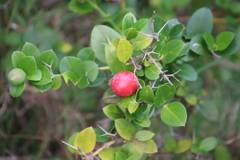
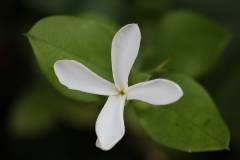
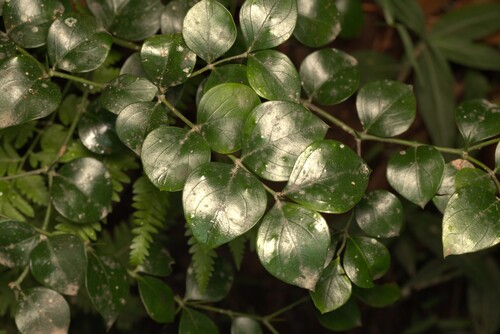
Carissa ovata is a spiny evergreen shrub growing 3-10 feet (1-3 m) tall, with rigid, interlacing branches and paired forked spines 0.4-1.2 inches (1-3 cm) long at the nodes. All parts contain a milky white latex. Leaves are opposite, leathery, oval to elliptic, 0.4-1.6 inches (1-4 cm) long, dark green and glossy above with a paler underside. Flowers are white, tubular at the base and opening into five spreading lobes 0.4-0.8 inch (10-20 mm) across, and are scented, opening mainly at night. The fruit is a rounded berry 0.4-0.8 inch (10-20 mm) across, ripening from green through red to glossy black, with sweet edible pulp surrounding two to four seeds; unripe fruit and other parts contain the bitter latex. The shrub forms dense, tangled thickets by branching and suckering, particularly on grazed or disturbed land. Growth is slow to moderate, and the spiny habit makes mature thickets close to impenetrable. Foliage is held year-round, and plants tolerate drought, heat, and periodic fire, resprouting from the base.
Native Range
Native to northern and eastern Australia, from Western Australia across the Northern Territory and Queensland to New South Wales, and also occurring in New Guinea and parts of Asia. Grows in open woodland, vine thickets, rocky outcrops, and grazing land in tropical and subtropical regions on a range of soils.Suggested Uses
Grown as a spiny barrier hedge, screening shrub, and habitat plant in dry tropical and subtropical gardens, spaced 3-6 feet (1-1.8 m) apart. Used in revegetation and as a refuge for small birds within the thorny canopy. The ripe black berries are edible and have a long history of Aboriginal use as bush food.How to Identify
Appearance
Size & Dimensions
Height3' - 10'
Width/Spread3' - 10'
Bloom Information
Flowers mainly in spring and summer, from September to February, with additional flowering after rain. Scented white flowers open largely in the evening and last one to two days each. Berries ripen over summer and autumn, turning from green to red to black, and a plant may carry flowers and ripening fruit at the same time.
Detailed Descriptions
Foliage Description
dark green, glossyGrowing Conditions
Sun Requirements
Requires 5-10 hours of direct sunlight daily
• Full Sun: 6+ hours of direct sunlight
• Partial Shade: 3-6 hours of direct sunlight
• Full Shade: Less than 3 hours of direct sunlight
Care & Maintenance
Care Guide
Grows in full sun to part shade on free-draining soils and tolerates drought, heat, and poor, rocky ground once established. Watering during the first one to two summers aids establishment, after which little supplementary water is needed. The milky latex and spines deter browsing, and few pests trouble the plant. It suckers and self-seeds where birds spread the fruit, and can form dense thickets on disturbed or overgrazed land. Hard frost damages foliage in cooler districts. Resprouts from the base after fire or cutting.Pruning
Tolerates hard pruning and shaping, carried out after fruiting; the spines make this slow work. Resprouts strongly from the base when cut low, which is used to renew old, woody plants. Trimming controls the spread of suckers and keeps hedging dense.Pruning Schedule
Prune: March–April
fall