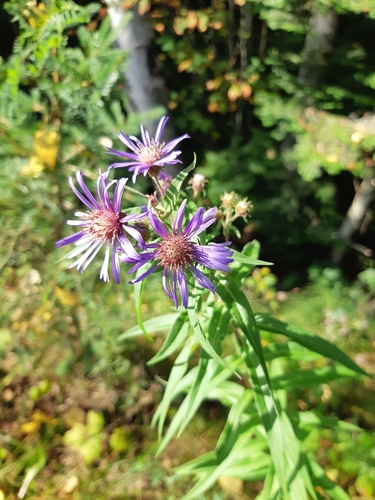
Canadanthus, Genus, modestus, Species,
- Genus & species
giant mountain aster
Mountainous western North America with disjunct eastern populations
Overview
Canadanthus modestus is a clump-forming herbaceous perennial reaching 24-48 inches (60-120 cm) tall and 12-24 inches (30-60 cm) wide via short rhizomes. Stems erect, leafy, glabrous below and finely glandular-pubescent in the upper third. Leaves alternate, lance-shaped to elliptic, 2-6 inches (5-15 cm) long with entire to finely toothed margins; basal leaves stalked, stem leaves sessile and clasping, dark green and slightly glandular. Flowers daisy-like, 1-1.5 inches (2.5-4 cm) wide, with 25-50 violet-purple ray florets surrounding a yellow central disc; borne 5-25 per stem in loose flat-topped panicles. Bloom July through September. Achenes 0.1-0.2 inch (3-5 mm) long with white pappus, dispersing on the wind in September-October. Spreads 4-8 inches (10-20 cm) per year by short rhizomes; mature clumps reach 18-24 inches (45-60 cm) wide within 3-5 years. Foliage dies back to ground level after first hard frost. Plants persist 8-15 years on moist subalpine sites; central crown weakens after 5-7 years and division restores flowering vigor.
Native Range
Native to mountainous western North America from Alaska and Yukon south through British Columbia, the Pacific Northwest, and Rocky Mountains to Wyoming and Colorado, with disjunct populations in Quebec and Newfoundland. Found in moist montane meadows, stream banks, forest edges, and aspen groves at 3,000-9,500 feet (900-2,900 m) elevation. Most populations occur in seasonally saturated subalpine sites.Suggested Uses
Used in moist meadow plantings, woodland edge, and montane native plant gardens at 18-24 inch (45-60 cm) spacing in zones 3-7. Stoloniferous habit suits naturalistic and restoration plantings; the clumping crown stays in scale with mixed perennial borders compared with many North American asters. Container culture is short-lived (2-3 seasons) due to its rhizomatous spread requirement.How to Identify
Appearance
Size & Dimensions
Height2' - 4'
Width/Spread1' - 2'
Bloom Information
July through September across the range, with peak bloom in August at mid-elevations and into early October above 7,000 feet (2,100 m). Individual flower heads last 1-2 weeks; total flowering on a single plant extends 5-7 weeks. Bloom is shorter and less abundant on dry sites or following dry winters.
Detailed Descriptions
Flower Description
Violet-purple with yellow centerFoliage Description
Dark greenGrowing Conditions
Sun Requirements
Requires 4-8 hours of direct sunlight daily
• Full Sun: 6+ hours of direct sunlight
• Partial Shade: 3-6 hours of direct sunlight
• Full Shade: Less than 3 hours of direct sunlight
Care & Maintenance
Care Guide
Plants establish from rhizome divisions or 4-inch (10 cm) container stock spaced 18-24 inches (45-60 cm) apart in spring. Maintain consistent moisture throughout the growing season; plants decline rapidly in summer drought below 30% soil moisture. Powdery mildew may develop on foliage in humid late summers; cosmetic only. Few pest pressures occur on natural sites; aphids may colonize stems in cultivation. Crown lifespan 8-15 years; central crown weakens after 5-7 years and division restores flower production. Stoloniferous spread is moderate at 4-8 inches (10-20 cm) per year and is contained by root barriers in mixed plantings.Pruning
Cut spent flower stems back to basal foliage in October to reduce wind dispersal of seed. Cut entire plant to ground level in late fall after first hard frost. Sucker shoots that escape the planting area can be lifted and transplanted in early spring.Pruning Schedule
Prune: October–November
fall
Container Growing
Minimum container size: 2 gallons