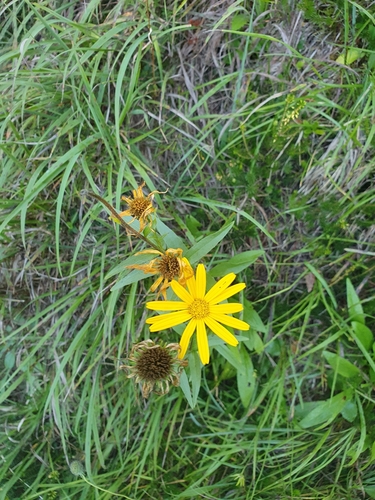
Buphthalmum, Genus, salicifolium, Species,
- Genus & species
willowleaf ox-eye
Central and southern Europe (France through Alps, Balkans, to Turkey)
Overview
Buphthalmum salicifolium is a clump-forming herbaceous perennial reaching 18–24 inches (45–60 cm) tall with a spread of 18–24 inches (45–60 cm). Upright to slightly arching stems carry alternate, narrow, lanceolate leaves 3–5 inches (8–13 cm) long and 0.3–0.8 inch (8–20 mm) wide, resembling willow leaves and giving the common name willowleaf ox-eye. Leaves are dark green, smooth above, with slightly hairy undersides. Daisy-like flower heads 2–2.5 inches (5–6 cm) across appear singly at stem tips from June through August. Ray florets are narrow and bright golden-yellow; disc florets are darker yellow. The slender ray florets produce a somewhat shaggy, finely textured flower compared with the broader rays of Helianthus or Heliopsis. Plants form a slowly expanding clump via short rhizomes. Growth rate is moderate, with clumps reaching full size in 2–3 years. Self-sowing is heavy in open, well-drained soils, and seedlings may become numerous in gravel gardens or along paths. In rich, moist soils, stems lean and require support.
Native Range
Buphthalmum salicifolium is native to central and southern Europe, from France east through the Alps, the Balkans, and into Turkey. It occurs in dry meadows, rocky slopes, woodland clearings, and limestone grasslands at elevations up to 5,000 feet (1,500 m), often on calcareous subalpine meadow soils.Suggested Uses
Used in sunny borders, cottage gardens, meadow plantings, and gravel gardens at 18–24 inch (45–60 cm) spacing. The narrow-leaved texture and golden-yellow flowers pair with grasses and other narrow-textured perennials in naturalistic and wildflower plantings on lean, calcareous soils, and stems cut at full bloom hold up as cut flowers. Grows in containers of at least 3 gallons (11 L); may self-sow heavily in open ground.How to Identify
Appearance
Size & Dimensions
Height1'6" - 2'
Width/Spread1'6" - 2'
Bloom Information
Daisy-like flower heads 2–2.5 inches (5–6 cm) across appear from June through August, solitary at stem tips. Ray florets are narrow and golden-yellow; disc florets are darker yellow. Bloom duration is 6–8 weeks, and deadheading extends the bloom period while limiting self-sowing. Seed heads are small and inconspicuous after ray florets drop.
Detailed Descriptions
Foliage Description
Dark green, narrow, willow-likeGrowing Conditions
Sun Requirements
Requires 6-10 hours of direct sunlight daily
• Full Sun: 6+ hours of direct sunlight
• Partial Shade: 3-6 hours of direct sunlight
• Full Shade: Less than 3 hours of direct sunlight
Care & Maintenance
Care Guide
Plant in well-drained, average to lean soil in full sun. Tolerates alkaline and chalky soils; native populations grow on limestone grasslands. Rich soils and excessive moisture produce lax, floppy stems that require staking, while lean, dry conditions produce more compact, self-supporting growth. Drought-tolerant once established. Regular deadheading limits self-sowing, which can be heavy in open, gravelly soils. Clumps divide every 3–4 years to maintain vigor, and the plant has no serious pest or disease problems.Pruning
Deadhead spent flowers through the bloom season to extend flowering and limit self-sowing. The entire plant is cut back to basal foliage in late fall or early spring. In rich soils, the Chelsea Chop (cutting stems by one-third in late May) produces shorter, sturdier stems less likely to flop.Pruning Schedule
Prune: March
early spring
Container Growing
Suitable for container growing
Minimum container size: 3 gallons