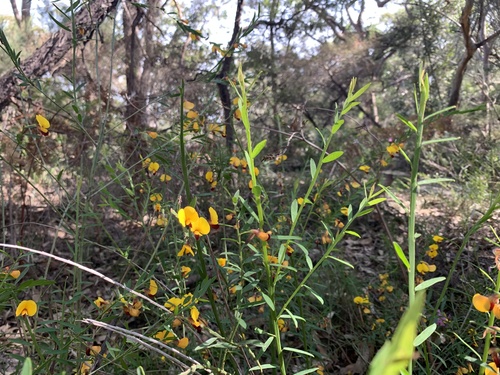
Bossiaea, Genus, spp., Multiple species,
- Genus
- Multiple species
leafless bitter-peas
Overview
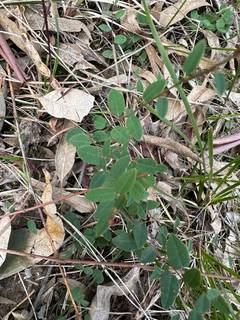
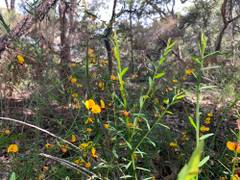
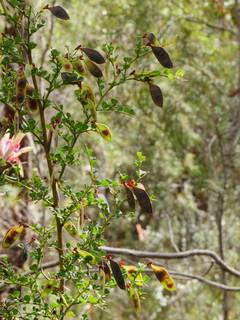
Bossiaea is a genus of about 75 to 80 species of legumes endemic to Australia, occurring across all mainland states in heath, sclerophyll forest, and woodland. Plants range from prostrate mats to erect shrubs 8 inches to 10 feet (0.2 to 3 m) tall. Many species have flattened green stems called cladodes that carry out photosynthesis, with true leaves reduced to small scales or absent; other species retain small alternate leaves. The pea-shaped flowers measure 0.4 to 0.8 inch (10 to 20 mm) across and are typically yellow with red, orange, or brown markings on the keel and wings. Flowering occurs mainly in spring. The fruit is a flattened pod 0.4 to 1.2 inches (10 to 30 mm) long containing several hard-coated seeds, many of which germinate after fire. Most species grow in nutrient-poor, sandy or rocky acidic soils and tolerate extended dry periods once established. Frost tolerance varies across the genus, with lowland species sensitive to hard frost and some montane species enduring light frost. As Australian natives adapted to specific regional conditions, Bossiaea species are uncommon in cultivation outside their native range and may be short-lived in soils that hold excess moisture.
Native Range
Bossiaea is endemic to Australia, distributed across all mainland states and territories from coastal heath to inland woodland and montane slopes. The greatest concentration of species occurs in southwestern Western Australia and southeastern Australia.Suggested Uses
Used in native and water-wise gardens, on embankments, and in coastal or heathland-style plantings across their native range. Lower-growing species are grown as groundcovers in sandy soils, while taller species are planted as informal screening. Spacing of 24 to 48 inches (60 to 120 cm) suits most shrubby forms.How to Identify
Appearance
Size & Dimensions
Height8" - 10'
Width/Spread8" - 8'
Bloom Information
Flowering occurs mainly in spring, between August and November in the Southern Hemisphere, with peak display over 4 to 6 weeks. Individual flowers are 0.4 to 0.8 inch (10 to 20 mm) across. Some species produce a lighter second flush after rain.
Detailed Descriptions
Flower Description
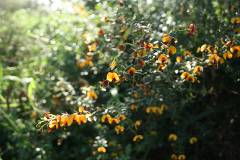
yellow with red and brown markingsFoliage Description
greenGrowing Conditions
Sun Requirements
Requires 6-10 hours of direct sunlight daily
• Full Sun: 6+ hours of direct sunlight
• Partial Shade: 3-6 hours of direct sunlight
• Full Shade: Less than 3 hours of direct sunlight