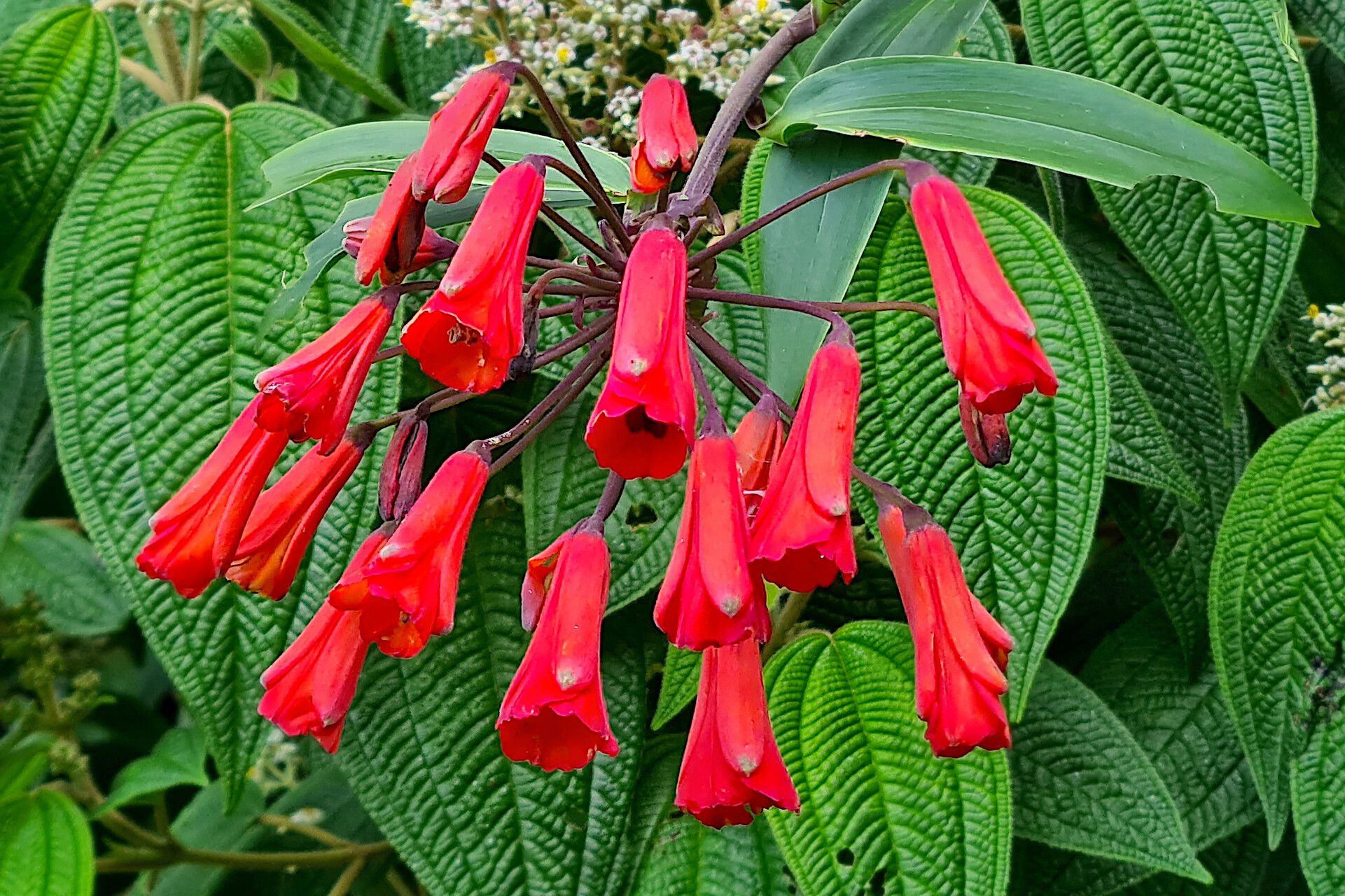
Bomarea, Genus, spp., Multiple species,
- Genus
- Multiple species
climbing alstroemerias
Mountains of Central and South America, centered in the Andes
Overview
Bomarea is a genus of about 120 species of mostly twining, herbaceous to woody climbing perennials in the family Alstroemeriaceae, native to the mountains of Central and South America. Most species climb 3–20 feet (0.9–6 m) by twining stems that rise each year from fleshy tuberous roots. Leaves are alternate, lance-shaped, 2–6 inches (5–15 cm) long, and like the related Alstroemeria are resupinate, twisting so the lower surface faces upward. Flowers hang in rounded terminal umbels of 5–40 blooms, each tubular to bell-shaped, 1–2.5 inches (2.5–6 cm) long, in orange, red, pink, or yellow, often spotted inside. The hanging clusters are pollinated by hummingbirds in the wild. Fruit is a capsule with seeds covered by a fleshy orange coat. A few species are frost-hardy in mild temperate gardens, while most are tender and limited to frost-free or montane climates. Stems die back in dry or cold seasons and resprout from the tubers.
Native Range
Native to the highlands and cloud forests of the Americas, from Mexico through the Andes to Chile and Argentina, with a few species in the Caribbean. Grows along forest margins, in scrub, and on slopes from about 3,000 to 13,000 feet (900–4,000 m), with the greatest diversity in the northern Andes.Suggested Uses
Grown on trellises, fences, and through shrubs in mild and frost-free gardens, and in containers with support in cooler regions, spaced 18–36 inches (45–90 cm) apart. The pendent flower clusters are cut for arrangements. Tender species are grown in conservatories where winters are cold.How to Identify
Appearance
Size & Dimensions
Height3' - 20'
Width/Spread2' - 4'
Bloom Information
Flowering comes in the warm or wet season, varying by elevation and species, often spring through summer in cultivation. Each umbel holds open over 2–4 weeks as individual flowers age. In frost-free climates some species flower over a long, irregular season.
Detailed Descriptions
Flower Description
orange, red, pink, to yellowFoliage Description
greenGrowing Conditions
Sun Requirements
Requires 4-8 hours of direct sunlight daily
• Full Sun: 6+ hours of direct sunlight
• Partial Shade: 3-6 hours of direct sunlight
• Full Shade: Less than 3 hours of direct sunlight
Care & Maintenance
Care Guide
Grows in full sun to part shade and moist, fertile, well-drained soil, with support for the twining stems. Plants need regular water during growth and a drier rest when stems die back. Hardy species tolerate light frost if the tubers are mulched, while tender species are damaged by any freeze. The brittle tubers resent disturbance, so plants are slow to establish after moving. Slugs and aphids feed on young shoots. Stems are cut down once they yellow at the end of the growing season.Pruning
Cut dead stems to the ground after they yellow and die back at the end of the season. Live twining stems need only guidance onto their support. Tubers can be divided in early spring as growth begins, though they re-establish slowly.Container Growing
Suitable for container growing
Minimum container size: 5 gallons
