Bignonia, Genus, spp., Multiple species,
- Genus
- Multiple species
crossvine
Central and southeastern United States
Overview
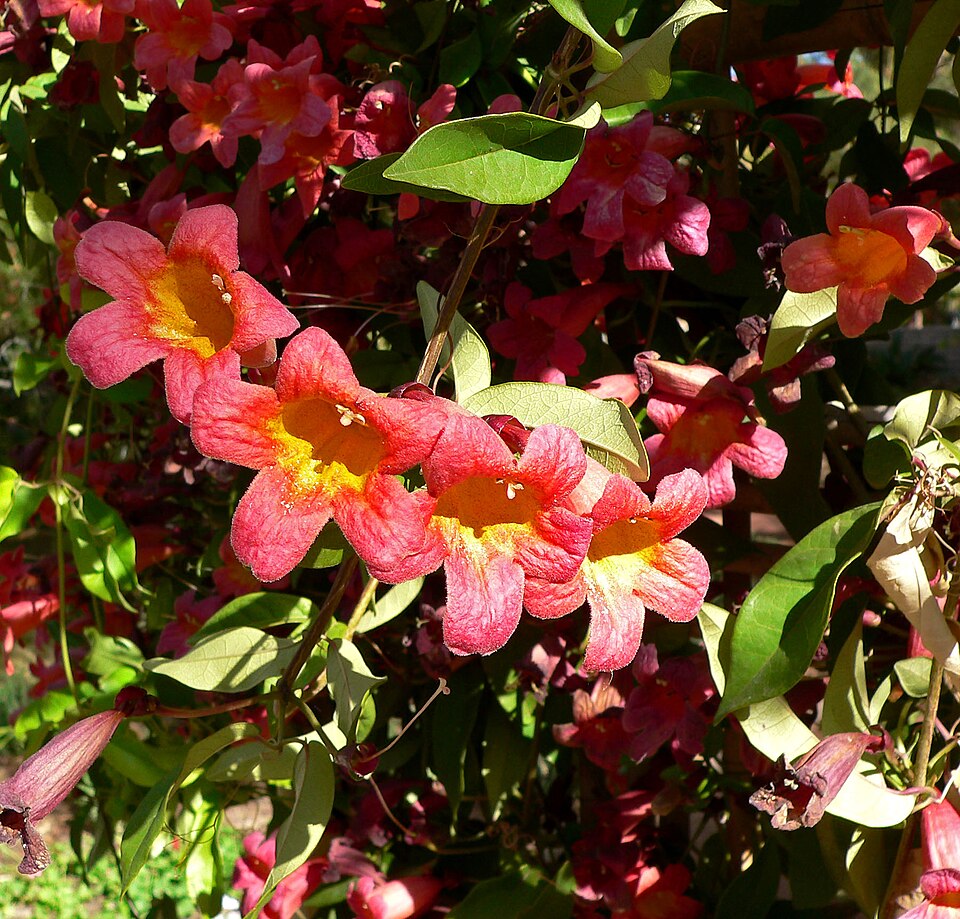
Bignonia is a genus in the trumpet-creeper family (Bignoniaceae); in current North American usage it is represented by the single species Bignonia capreolata, known as crossvine, while many plants once placed here have been moved to other genera. Crossvine is a woody, high-climbing evergreen to semi-evergreen vine that ascends 30-50 feet (9-15 m) by branched tendrils tipped with adhesive disks, allowing it to grip masonry and bark. The paired leaves each consist of two leaflets with a tendril between them, and the foliage often turns reddish-purple in cold weather. In mid to late spring the vine carries clusters of trumpet-shaped flowers 1.5-2 inches (4-5 cm) long, orange-red outside and yellow within, followed by flattened bean-like seed capsules. A cut stem shows a cross-shaped pattern in the pith, which is the source of the common name. Bignonia grows in moist woodlands and stream banks in the southeastern United States. The vigorous growth can climb high and cover supports densely, so it needs space and a sturdy structure.
Native Range
Native to the central and southeastern United States, in bottomland forests, swamp edges, fencerows, and along stream banks. Bignonia capreolata ranges from the Mid-Atlantic states south to Florida and west to Texas.Suggested Uses
Grown on walls, fences, arbors, and large trellises for spring flowers and evergreen cover, and used to screen structures or clothe sturdy vertical supports. The flowers draw hummingbirds, and the dense growth gives nesting cover for birds.How to Identify
Appearance
Size & Dimensions
Height30' - 50'
Width/Spread6' - 9'
Bloom Information
Flowering peaks in mid to late spring, roughly April to May, with a scattering of later blooms through summer. The trumpet flowers are followed by long, flattened seed capsules. Bloom is heaviest on stems grown in full sun.
Detailed Descriptions
Flower Description
Orange-red with yellow throatFoliage Description
Dark greenGrowing Conditions
Sun Requirements
Requires 6-10 hours of direct sunlight daily
• Full Sun: 6+ hours of direct sunlight
• Partial Shade: 3-6 hours of direct sunlight
• Full Shade: Less than 3 hours of direct sunlight
Care & Maintenance
Care Guide
Bignonia grows in full sun to partial shade in moist, fertile, well-drained soil, and tolerates clay and short dry spells once established. Flowering is fullest in full sun, while shaded plants climb strongly but bloom less. The vine clings to masonry, fences, and tree trunks by adhesive tendrils and needs sturdy support. It spreads by suckers and rooting stems, forming large colonies if unmanaged. Propagation is by seed, cuttings, or rooted layers.Pruning
Pruning is done right after flowering to control size and direct growth, since flower buds form on older wood. Overgrown vines tolerate hard cutting back and resprout strongly. Suckers are removed to limit spread.Pruning Schedule
Prune: May–June
late springsummer