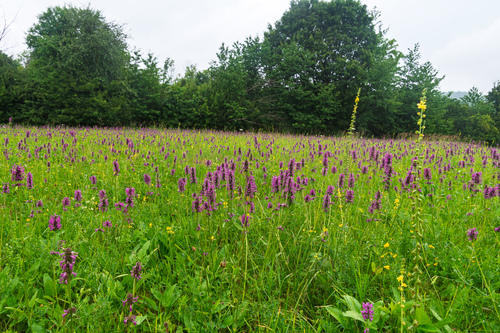
Betonica, Genus, officinalis, Species,
- Genus & species
common hedge-nettle
Europe, North Africa, and western Asia
Overview
Betony is a clump-forming herbaceous perennial in the mint family, growing 12-24 inches (30-60 cm) tall and 12-18 inches (30-45 cm) wide. It builds a low basal rosette of dark green, oblong leaves 2-5 inches (5-12 cm) long with scalloped margins and a deeply wrinkled, veined surface. From this rosette rise slender, square stems, each topped by a dense cylindrical spike 1-3 inches (2.5-8 cm) long packed with two-lipped flowers. Individual flowers measure about 0.5 inch (12 mm) and open reddish-purple to magenta, occasionally white in cultivated forms. The basal foliage is semi-evergreen in mild climates, persisting through winter as a flat green mat. Betonica officinalis spreads slowly by short rhizomes to form tight colonies rather than running, which keeps it manageable in mixed plantings. Bloom is concentrated in midsummer, and after the spikes fade the seed heads remain upright into autumn. The plant grows across a wide pH range and tolerates poor soils, but flowering thins in deep shade and in soils that stay waterlogged in winter. Long cultivated as a medicinal herb in Europe, it is grown today mainly for its summer flower spikes and weed-suppressing foliage mat.
Native Range
Native to Europe, extending into North Africa and western Asia. Betonica officinalis grows wild in grasslands, heaths, hedgerows, and open woodland across the European continent and the British Isles.Suggested Uses
Planted in the front to middle of borders, in cottage gardens, and in wildflower or prairie-style plantings, where its upright spikes contrast with mounded perennials. The dense basal foliage suppresses weeds as an edging or small-scale groundcover. It suits pollinator and herb gardens.How to Identify
Appearance
Size & Dimensions
Height1' - 2'
Width/Spread1' - 1'6"
Bloom Information
Blooms from June to September, peaking in July and August. The terminal spikes open from the bottom upward over two to three weeks, and side shoots extend the display. Removing faded spikes can bring a lighter second flush in early autumn.
Detailed Descriptions
Flower Description
reddish-purple to magentaFoliage Description
dark greenGrowing Conditions
Sun Requirements
Requires 4-8 hours of direct sunlight daily
• Full Sun: 6+ hours of direct sunlight
• Partial Shade: 3-6 hours of direct sunlight
• Full Shade: Less than 3 hours of direct sunlight
Care & Maintenance
Care Guide
Grows in full sun to part shade in average, well-drained soil with a pH from 5.5 to 7.5. Established plants tolerate short dry spells but flower most freely with steady summer moisture. Heavy clay soil that stays wet in winter can rot the crown, so sharp drainage matters on cold, damp sites. No routine feeding is needed, and lean soils produce sturdier, more upright stems than rich ones. Clumps can be lifted and divided every three to four years in spring or autumn to maintain vigor. The semi-evergreen rosettes are left in place over winter and tidied in early spring.Pruning
Spent flower spikes are cut back to the basal foliage after bloom to limit self-seeding and prompt rebloom. Tattered old leaves are removed in late winter before new growth emerges. The basal rosette is otherwise left intact through the cold months.Pruning Schedule
Prune: July–September
summerfall
Container Growing
Suitable for container growing