Bebbia, Genus, juncea, Species,
- Genus & species
Sweetbush
Southwestern United States and Mexico
Overview
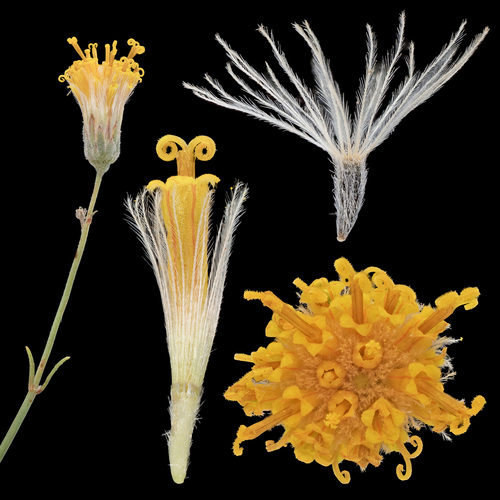
Bebbia juncea is a rounded, intricately branched shrub reaching 2-4 feet (60-120 cm) tall and about as wide, built from slender, rush-like green stems that carry out most of the plant's photosynthesis. Leaves are sparse, narrow, and 0.4-1.2 inches (1-3 cm) long, dropping early in the season so that mature plants appear nearly leafless. Flower heads are about 0.4 inch (1 cm) across and lack ray florets, holding 15-30 yellow disc florets that open from spring through fall whenever moisture allows. The heads are mildly fragrant and give way to seeds tipped with feathery, tawny pappus bristles. Stems are rough to the touch and break the desert sun into a thin green haze. Growth is moderate, supported by a deep root system that carries the plant through long dry spells; in extended drought the stems turn grayish and growth halts until rain returns. The brittle stems break easily under foot traffic or heavy grazing.
Native Range
Native to the deserts of the southwestern United States, from southern California and Nevada to Arizona, Utah, New Mexico, and Texas, and south through Baja California and northern mainland Mexico. Grows in washes, canyons, rocky slopes, and roadside cuts below 5,000 feet (1,500 m).Suggested Uses
Planted in desert and xeric gardens, revegetation projects, and erosion control on dry slopes, spaced 3-5 feet (90-150 cm) apart. The flowers draw native bees, butterflies, and other desert pollinators, and the foliage is browsed by desert tortoises and chuckwallas. Less suited to high-traffic areas, where the brittle stems break.How to Identify
Appearance
Size & Dimensions
Height2' - 4'
Width/Spread2' - 4'
Bloom Information
Flowers mainly from March through June, then again in late summer and fall after rains, so a plant may bloom in several flushes across the warm season. Each flush lasts about 2-4 weeks. Flowering depends on soil moisture and is sparse in rainless periods.
Detailed Descriptions
Foliage Description
greenGrowing Conditions
Sun Requirements
Requires 6-12 hours of direct sunlight daily
• Full Sun: 6+ hours of direct sunlight
• Partial Shade: 3-6 hours of direct sunlight
• Full Shade: Less than 3 hours of direct sunlight
Care & Maintenance
Care Guide
Grows in full sun on sharp-draining, rocky, sandy, or decomposed-granite soils of low fertility. Once established it survives on rainfall alone, drawing on a deep root system; occasional deep irrigation in the hottest months extends bloom. Overwatering and heavy, poorly drained soils cause root rot. The brittle stems snap under foot traffic, so open spacing reduces stem breakage. Pests and diseases are few. Plants live many years but become open and woody at the base with age, when a hard cutback renews them.Pruning
Cut back by one-third to one-half in late winter to hold a dense, rounded form and remove brittle dead stems. The plant resprouts from the woody base after hard pruning. Light shearing after each bloom flush clears the spent seedheads.Pruning Schedule
Prune: February
winter
Container Growing
Suitable for container growing
Minimum container size: 5 gallons