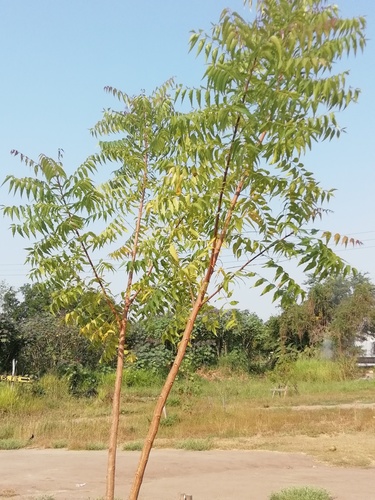
Azadirachta, Genus, spp., Multiple species,
- Genus
- Multiple species
neem
Indian subcontinent and Southeast Asia
Overview
Azadirachta is a small genus of evergreen to semi-deciduous trees in the family Meliaceae, which includes the neem tree, A. indica. Trees reach 50-65 feet (15-20 m) tall, and A. excelsa can exceed 130 feet (40 m), with straight trunks and rounded to spreading crowns 30-65 feet (9-20 m) wide. Leaves are alternate and pinnately compound, 8-16 inches (20-40 cm) long, with 8-19 curved, toothed leaflets 1.5-3 inches (4-8 cm) long. Small white flowers, about 0.2-0.4 inch (5-10 mm) across, are honey-scented and borne in drooping panicles. The fruit is a smooth, olive-like drupe 0.5-1 inch (1.3-2.5 cm) long, ripening from green to yellow, with a single seed. Trees are evergreen in moist climates but shed leaves briefly during severe drought. Seeds, leaves, and bark contain azadirachtin and related compounds used as insecticides. Growth is rapid, with trees reaching flowering size in 3-5 years, though the wood is brittle and limbs break in storms.
Native Range
Native to the Indian subcontinent and parts of Southeast Asia, with A. indica ranging across India, Pakistan, Bangladesh, and Myanmar, and A. excelsa in the Malesian region. A. indica has been planted and naturalized across the dry tropics of Africa, the Middle East, and the Americas. Plants grow in tropical and subtropical lowlands below about 4,900 feet (1,500 m), tolerating long dry seasons.Suggested Uses
Planted as a shade and street tree in hot dry climates and in agroforestry windbreaks, spaced 16-30 feet (5-9 m) apart. Seeds and leaves are processed for neem oil and botanical insecticides. The dense canopy is used for shade over courtyards and livestock yards in the tropics.How to Identify
Appearance
Size & Dimensions
Height50' - 65'
Width/Spread30' - 65'
Bloom Information
Flowering occurs mainly in spring, from March to May across much of the natural range, with a lighter flush at other times in equatorial climates. Panicles open over 2-4 weeks. Fruit ripens through summer, 10-12 weeks after flowering.
Detailed Descriptions
Foliage Description
greenGrowing Conditions
Sun Requirements
Requires 6-12 hours of direct sunlight daily
• Full Sun: 6+ hours of direct sunlight
• Partial Shade: 3-6 hours of direct sunlight
• Full Shade: Less than 3 hours of direct sunlight
Care & Maintenance
Care Guide
Trees grow in full sun in a wide range of well-drained soils, including poor, sandy, and rocky ground, but decline in waterlogged or compacted sites. Established trees are deeply drought-tolerant and survive on 18-30 inches (450-760 mm) of annual rainfall, though growth slows in extended drought. Young trees need watering through the first two or three dry seasons. Plants are damaged below about 35 F (2 C) and killed by frost. Few serious pests occur because the foliage contains natural insecticidal compounds, though scale and root rot appear in poor conditions. Trees coppice readily and resprout after cutting.Pruning
Prune in the dry season to remove dead or crossing limbs and to raise the canopy. Trees tolerate hard cutting back and coppicing, resprouting from the stump. Brittle limbs that overhang structures can be shortened to reduce storm breakage.Pruning Schedule
Prune: January–February
winter
