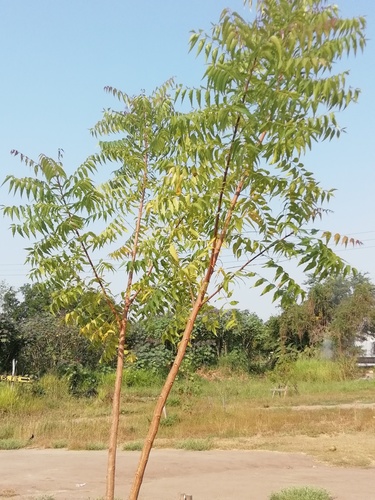
Azadirachta, Genus, indica, Species,
- Genus & species
neem tree
Dry deciduous forests of the Indian subcontinent — India, Pakistan, Bangladesh, Sri Lanka, and Myanmar; naturalized across tropical Africa, the Middle East, the Caribbean, parts of the Americas, Hawaii, and northern Australia
Overview
Azadirachta indica is the neem tree — a fast-growing evergreen shade and economic tree of the Indian subcontinent grown across the tropics, reaching 30–60 ft (9–18 m) tall and 25–50 ft (7.5–15 m) wide at maturity. The species is native to the dry deciduous forests of India, Pakistan, Bangladesh, Sri Lanka, and Myanmar, and has been used in Ayurvedic medicine and Indian agriculture for over 2,000 years for its insect-repellent and antimicrobial seed-oil compounds. Each leaf is pinnately compound, 8–14 inches (20–35 cm) long, with 8–18 toothed lance-shaped leaflets 1–2 inches (2.5–5 cm) long arranged opposite along a central rachis; the foliage is medium green and casts a light to medium shade. Small white star-shaped fragrant flowers in panicles 4–10 inches (10–25 cm) long appear in late winter and spring, followed by olive-shaped yellow drupes 0.6–0.8 inch (15–20 mm) long that ripen in summer. The drupes contain neem seeds, which are pressed for the bitter yellow-brown neem oil used commercially as a horticultural insecticide and a personal-care ingredient; the active compound azadirachtin disrupts insect feeding and molting and has low mammalian toxicity at typical exposure levels but is toxic to dogs and cats at higher doses, with seed and oil ingestion causing vomiting, lethargy, and seizures. The tree tolerates drought, poor soils, salinity, and air pollution, and is widely planted as a street tree across South Asia, Africa, the Middle East, and the Caribbean. Hardy outdoors only in USDA zones 10–12; brief frost causes leaf drop and the tree dies in temperatures below 25°F (−4°C).
Native Range
Azadirachta indica is native to the dry deciduous forests of the Indian subcontinent, with a range from India and Pakistan east through Bangladesh and Sri Lanka to Myanmar, and naturalized in tropical Africa, the Middle East, the Caribbean, parts of the Americas, Hawaii, and northern Australia.Suggested Uses
Used as a shade and street tree across the tropics, on farms as an insect-repellent windbreak, and as a source of neem oil and leaves for traditional medicine and agriculture in zones 10–12. The tree's drought, salt, and pollution tolerance suit harsh urban and coastal sites where most shade trees fail. Less suited to regions where the species is invasive (parts of West Africa, the Caribbean, Hawaii, and northern Australia), and the seed and oil toxicity to dogs and cats applies to households with pets that browse fallen drupes.How to Identify
Appearance
Size & Dimensions
Height30' - 60'
Width/Spread25' - 50'
Bloom Information
Flowers from late February through May for approximately 8 weeks across USDA zones 10–12; bloom timing varies by latitude in the tropics. Small white star-shaped fragrant flowers in panicles 4–10 inches (10–25 cm) long, followed by olive-shaped yellow drupes 0.6–0.8 inch (15–20 mm) long that ripen in summer. Sweet jasmine-like fragrance from the flowers.
Detailed Descriptions
Flower Description
Small white star-shaped fragrant flowers in panicles 4-10 inches (10-25 cm) longFoliage Description
Medium green pinnately compound leaves 8-14 inches (20-35 cm) long with 8-18 toothed lance-shaped leaflets 1-2 inches (2.5-5 cm) longGrowing Conditions
Sun Requirements
Requires 6-12 hours of direct sunlight daily
• Full Sun: 6+ hours of direct sunlight
• Partial Shade: 3-6 hours of direct sunlight
• Full Shade: Less than 3 hours of direct sunlight