Arum, Genus, italicum, Species,
- Genus & species
lords and ladies
Europe, North Africa, and western Asia; found in deciduous woodlands, hedgerows, and disturbed sites on calcareous or neutral soils; classified as invasive in the Pacific Northwest region of North America (Oregon, Washington, and British Columbia) and in scattered populations across California, the Mid-Atlantic states, and parts of New England
Overview
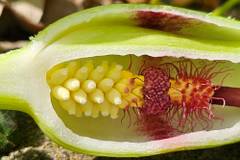
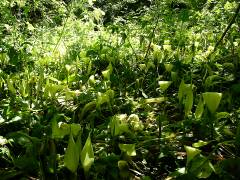
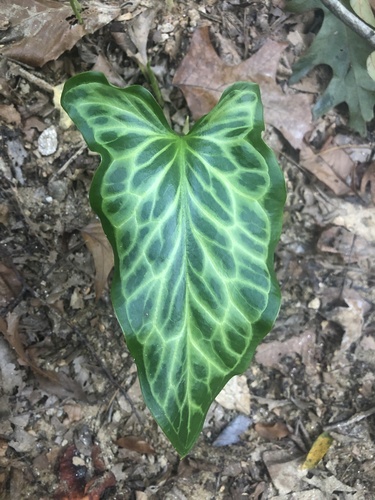
Arum italicum is a tuberous clumping semi-evergreen perennial in the family Araceae native to Europe, North Africa, and western Asia, reaching 12-18 inches (30-45 cm) tall and wide at maturity. The defining trait of the species is a reversed annual lifecycle compared to most temperate garden perennials — foliage emerges from the underground tuber in fall (October) and persists through winter and spring before dying back to the tuber in early summer, leaving the plant fully dormant from July through September before the next foliage flush emerges in fall. This winter-active, summer-dormant cycle makes the species a working source of ornamental foliage interest during a season when most other shade perennials are dormant or leafless, which is the main argument for cultivation. Leaves are dark green, arrow-shaped (hastate), and 6-12 inches (15-30 cm) long, and all cultivated forms carry cream to white veining along the leaf venation pattern — the cultivar 'Marmoratum' (also sold as 'Pictum') carries the most prominent cream veining and is widely grown as a foliage plant in winter shade gardens. A pale green to cream spathe 6-8 inches (15-20 cm) long surrounds a yellow-green spadix and opens in April and May, though the flower structure is inconspicuous compared to the patterned winter foliage that precedes it and the bright orange-red berry cluster 0.3 inch (8 mm) across that emerges on a bare stalk in August after the foliage has died back to the ground. Pollination is by flies attracted by a mild carrion-like scent emitted by the spadix during bloom. The species is classified as invasive in the Pacific Northwest region of North America (Oregon, Washington, and the coastal lowlands of British Columbia) where it escapes cultivation into moist deciduous woodlands, spreads aggressively by bird-dispersed seed and tuberous offsets, and forms dense mats that exclude native understory flora; the Oregon Department of Agriculture lists the species as a noxious weed, and smaller invasive populations have been documented across California, the Mid-Atlantic states, and parts of New England. All parts of the plant contain calcium oxalate crystals (raphides) and ingestion causes intense burning and swelling of the mouth, lips, tongue, and throat in humans, dogs, cats, and livestock, and the bright orange-red late-summer berries are the most common source of accidental poisoning in children because of the visual appeal of the ripe berry cluster held on a bare stalk without any surrounding foliage. Deer browse is rare because of the calcium oxalate content. The species is not drought-tolerant and requires consistently moist soil through the fall, winter, and spring foliage period.
Native Range
Arum italicum is native to southern and western Europe (from Britain and Ireland south through France, Spain, Portugal, Italy, and the Balkans), North Africa (Morocco, Algeria, Tunisia), and western Asia (Turkey and the Caucasus). The species grows wild in deciduous woodlands, hedgerows, shady roadside banks, and disturbed sites on calcareous or neutral soils at low to mid elevations. The species has been cultivated in European gardens for centuries and was introduced to North American ornamental horticulture in the 19th century, and the winter-active lifecycle makes it adapted to Mediterranean and Atlantic climate regions where winter temperatures remain above approximately 10°F (-12°C). The species has naturalized aggressively in the Pacific Northwest, parts of California, and scattered locations across the Mid-Atlantic and New England where climate conditions match its winter-growing habit.Suggested Uses
Planted as a winter ground cover, foliage feature, and shade garden accent beneath deciduous trees at 12-18 inch (30-45 cm) spacing in zones 6-9. The winter-active foliage with cream veining fills gaps in shade plantings during October through May when most other woodland perennials are dormant, and the species combines well with spring-flowering bulbs (Galanthus, Eranthis, early Narcissus) that share the same winter-spring growing window. The dead-foliage summer gap is often filled by summer-active companions such as ferns, Hosta, or Heuchera that emerge as the arum foliage dies back, producing a continuous foliage display across the full year. Not suited to planting anywhere in the Pacific Northwest region of North America where the species is listed as a noxious weed and escapes cultivation into native woodland (Oregon has formal invasive classification), full sun positions where the winter foliage scorches on cold sunny days, sites with unsupervised access by children or pets where the bright orange-red berries create an ingestion poisoning risk, or dry drought-prone positions during fall through spring where insufficient soil moisture during the active growing period stunts the foliage display.How to Identify
Appearance
Size & Dimensions
Height1' - 1'6"
Width/Spread1' - 1'6"
Colors
Bloom Information
Pale green to cream spathes 6-8 inches (15-20 cm) long surround yellow-green club-shaped spadices during April and May in zones 6-9, lasting approximately 4 weeks of bloom. The flower structure is inconspicuous compared to the patterned winter foliage that precedes it and the bright orange-red berry cluster that follows in August. Pollination is carried out by flies attracted by a mild carrion-like scent emitted by the spadix during bloom, and the spathe acts as a short-term trap for small flies through downward-pointing hairs that prevent pollinators from exiting until the spadix has released pollen. Bright orange-red berry clusters 0.3 inch (8 mm) across ripen on a bare stalk in August after the foliage has died back to the ground, and the berries are dispersed by birds during late summer and fall.
Detailed Descriptions
Flower Description
pale green to cream spathe 6-8 inches (15-20 cm) long surrounding a yellow-green club-shaped spadix; the flower structure is inconspicuous compared to both the patterned foliage earlier in the year and the orange-red berry cluster that follows in late summerFoliage Description
dark green with cream to white veining that follows the leaf venation pattern; arrow-shaped (hastate) blades 6-12 inches (15-30 cm) long carried on long petioles; foliage emerges in fall (October) and persists through winter and spring before dying back to the tuber in summer; the cultivar 'Marmoratum' (syn. 'Pictum') carries the most prominent cream veining and is widely grown for foliage interestGrowing Conditions
Sun Requirements
Requires 1-4 hours of direct sunlight daily
• Full Sun: 6+ hours of direct sunlight
• Partial Shade: 3-6 hours of direct sunlight
• Full Shade: Less than 3 hours of direct sunlight
Care & Maintenance
Care Guide
Plant tubers 4-6 inches (10-15 cm) deep in late summer or early fall in moist humus-rich soil with a pH of 5.5-7.0 in part shade to full shade (1-4 hours of sun). The species is not drought-tolerant and requires consistently moist soil through the fall, winter, and spring foliage period, with summer drought after the foliage dies back being acceptable because the tubers are naturally dormant during the hot dry season. Tattered summer-dormant foliage is removed in July or August as it withers. The plant dies back to the tuber by early July and reemerges in October, so the position appears empty from July through September — this dormant gap is a planning consideration for garden design. The species is classified as invasive in the Pacific Northwest region of North America (Oregon, Washington, British Columbia) where it escapes cultivation into native woodland, and the Oregon Department of Agriculture lists it as a noxious weed; planting the species in the Pacific Northwest requires review of state invasive-species regulations, and removal of self-sown seedlings from the parent plant vicinity is the standard containment practice in regions where cultivation remains legal. All parts of the plant contain calcium oxalate crystals and are toxic to humans, dogs, cats, and livestock on ingestion, with the bright orange-red late-summer berries being the most common source of accidental poisoning in children. Deer browse is rare because of the calcium oxalate content.Pruning
No pruning is needed during active growth. Tattered summer-dormant foliage is removed in July and August as it withers if visible cleanup is wanted, though the foliage usually breaks down on its own within a few weeks of going dormant. Self-sown seedlings emerging around the parent plant are removed promptly to control unwanted spread, particularly in regions where the species is classified as invasive. The berry stalk can be removed after the berries have dropped in late fall, or left to complete its natural cycle of bird dispersal.Pruning Schedule
Prune: August
summer