Ardisia, Genus, japonica, Species,
- Genus & species
Marlberry
Japan, Korea, and central and southern China
Overview
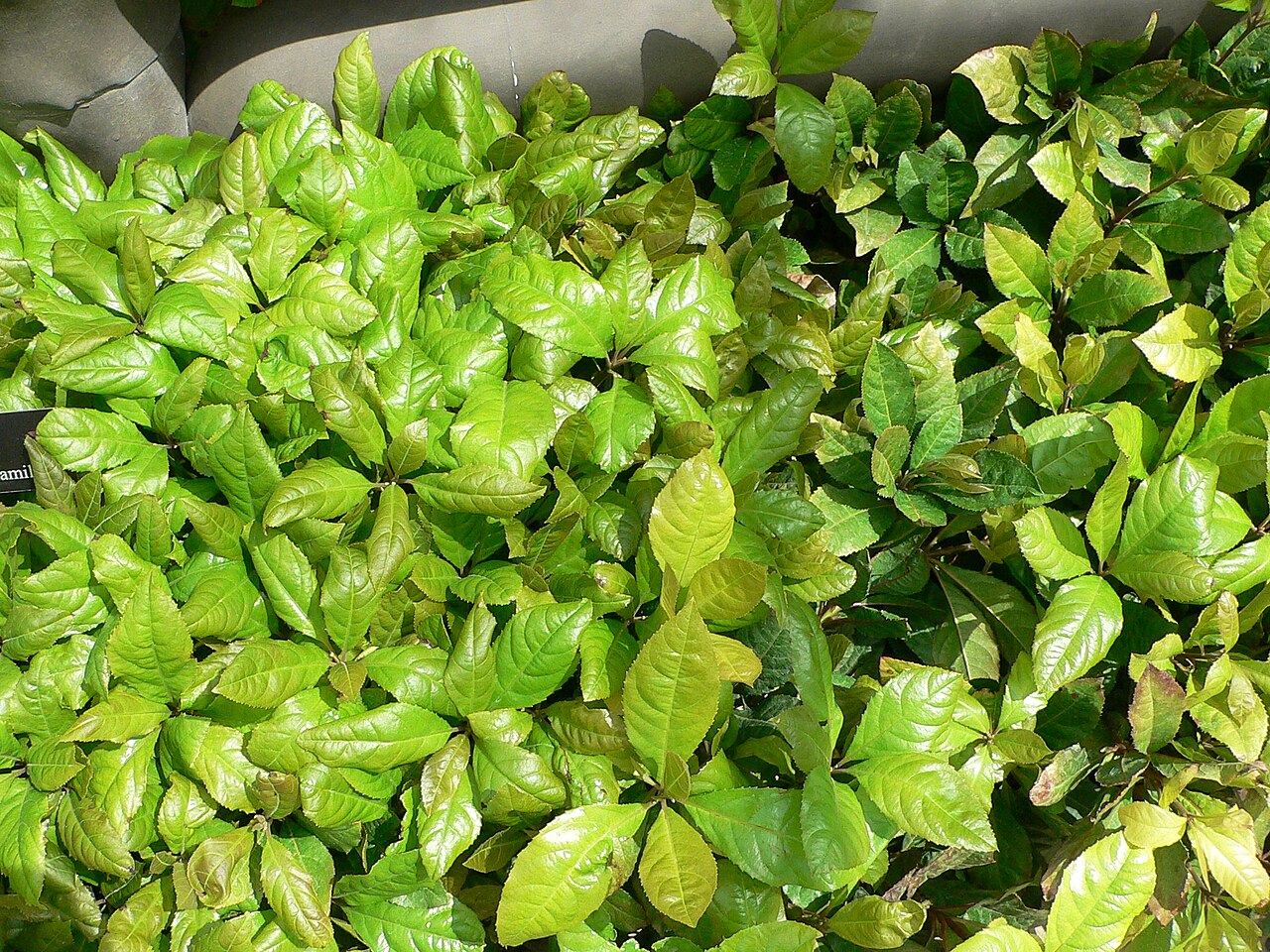
Ardisia japonica is an evergreen rhizomatous subshrub in the Primulaceae, growing 8–16 inches (20–40 cm) tall and spreading by underground rhizomes into colonies, with individual crowns 12–36 inches (30–90 cm) across. Stems are unbranched and upright, carrying leaves in whorls of three to four crowded near the tip so the lower half of each stem stays bare. Leaves are elliptic, 2–4 inches (5–10 cm) long and 1–1.5 inches (2.5–4 cm) wide, glossy dark green with serrate margins and a leathery texture. Flowers are white to pale pink, star-shaped and about 0.25 inch (6 mm) across, nodding in axillary clusters of 2–6 during July and August. Fruit is a round red drupe about 0.25 inch (6 mm) across that ripens in autumn and persists through winter into the following spring. Rhizomes extend 4–8 inches (10–20 cm) a year and push through the crowns of neighbouring low perennials. The species has naturalised in parts of the southeastern United States after spreading from garden plantings, both by rhizome and by bird-dispersed fruit. More than 100 variegated selections are grown in Japan under the name yabukoji.
Native Range
Ardisia japonica is native to Japan, Korea, and central and southern China. It grows in the understorey of moist evergreen and mixed forest, on shaded slopes and stream banks, from near sea level to about 4,000 feet (1,200 m). In China the roots and stems are gathered under the name zi jin niu for use in traditional medicine.Suggested Uses
Planted as a shade groundcover under trees and shrubs, spaced 12–18 inches (30–45 cm) apart for closed cover in three to four seasons. Also grown in containers of 2 gallons (7.5 L) or larger, the method used for the variegated Japanese selections. Rhizomatous spread and bird-dispersed fruit have led to naturalisation in parts of the southeastern United States, and plantings there are edged annually to contain the colony.How to Identify
Appearance
Size & Dimensions
Height8" - 1'4"
Width/Spread1' - 3'
Bloom Information
Flowering runs about four weeks across July and August, later in the season than most woodland groundcovers. Flowers hang in clusters of 2–6 from the leaf axils on stalks 0.2–0.4 inch (5–10 mm) long, each with five reflexed lobes in white to pale pink around a ring of dark anthers. Individual flowers span about 0.25 inch (6 mm) and sit beneath the whorled leaves, so they are seen mainly from below. Fruit sets through autumn and colours red by October, holding on the stems until the following spring.
Detailed Descriptions
Flower Description
White to pale pinkFoliage Description
Glossy dark greenGrowing Conditions
Sun Requirements
Tolerates up to 4 hours of direct sunlight daily
• Full Sun: 6+ hours of direct sunlight
• Partial Shade: 3-6 hours of direct sunlight
• Full Shade: Less than 3 hours of direct sunlight
Care & Maintenance
Care Guide
Zero to four hours of direct sun daily suits the foliage; leaves yellow and the margins scorch where plants receive full midday sun. Moist, humus-rich soil with a pH of 5.0 to 6.5 supports rhizome spread, and growth stalls in compacted or alkaline ground. Watering during dry spells longer than two weeks holds the leaves turgid, since the rhizomes sit in the top 3–4 inches (7.5–10 cm) of soil and dry out quickly. The plant is hardy in USDA zones 7–9, with foliage damaged below about 10°F (-12°C) and stems killed to the rhizome near 0°F (-18°C), from which they resprout. A 1–2 inch (2.5–5 cm) leaf mulch each autumn maintains the surface organic layer the rhizomes root into. Scale insects and root rot in saturated soil are the recurring problems, and colonies thin where tree roots take the available moisture.Pruning
Winter-damaged stems are cut to the ground in March or early April, and the rhizomes send up replacements within about six weeks. Shortening individual stems produces no branching, since growth resumes only from the rhizome, so renewal is carried out by cutting whole stems at ground level. Colonies that have spread beyond their space are contained by cutting a vertical edge 6 inches (15 cm) deep each spring. Division in early spring, lifting rhizome sections with 2–3 stems attached, re-establishes over one season.Pruning Schedule
Prune: March–April
early spring
Container Growing
Suitable for container growing
Minimum container size: 2 gallons