Overview
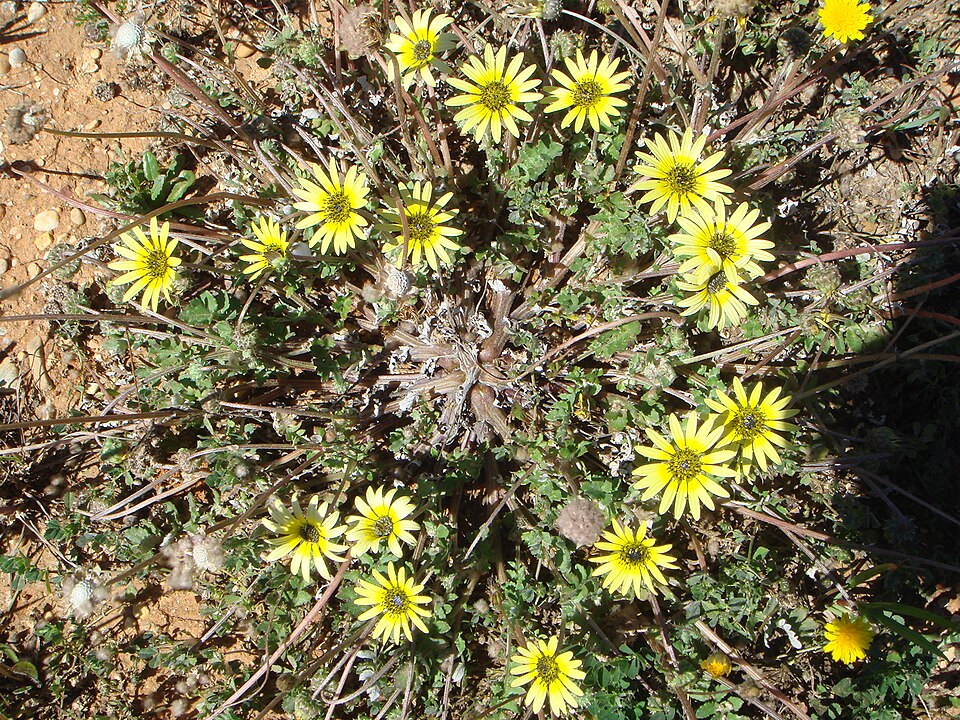
Arctotheca calendula is a low annual herb in the daisy family, native to South Africa and now a widespread weed across southern Australia, where it invades pastures, lawns, roadsides, and disturbed ground. Plants form a flat rosette of lobed, deeply toothed leaves 2-10 inches (5-25 cm) long, dark green above and covered in white woolly hairs beneath. From late winter into spring each rosette sends up bright yellow daisy flowers about 1-1.5 inches (2.5-4 cm) across on short stalks, with a darker purple-black centre. The flowers close at night and in dull weather. A single plant can produce hundreds of woolly seeds that spread on wind, water, animals, and machinery, allowing dense infestations to build quickly. Capeweed can accumulate nitrates to levels harmful to grazing livestock. It grows fast on a wide range of soils and dies off as the soil dries in summer, leaving bare patches. Its aggressive spread makes it an unwelcome plant in gardens and farmland.
Native Range
Native to South Africa. Widely naturalized in southern Australia, New Zealand, California, and parts of the Mediterranean, where it has become an invasive weed of pasture and disturbed land.Suggested Uses
Has no garden use and is treated as a weed of lawns, pastures, and crops. Dense stands act as early-season ground cover and bee forage on disturbed land, but crowd out other plants. Control rather than planting is the usual aim.How to Identify
Appearance
Size & Dimensions
Height4" - 1'
Width/Spread8" - 1'8"
Bloom Information
Bright yellow daisy flowers appear from late winter into spring, mainly August to November, opening on sunny days and closing at night. Flowering continues for many weeks while soil moisture lasts. Each flower head ripens into a cluster of woolly wind-borne seeds.
Detailed Descriptions
Flower Description
yellow with dark centreFoliage Description
dark green, white-woolly beneathGrowing Conditions
Sun Requirements
Requires 6-10 hours of direct sunlight daily
• Full Sun: 6+ hours of direct sunlight
• Partial Shade: 3-6 hours of direct sunlight
• Full Shade: Less than 3 hours of direct sunlight
Water & Climate
Water Needs
Drought Tolerance
Drought tolerant when established