Overview
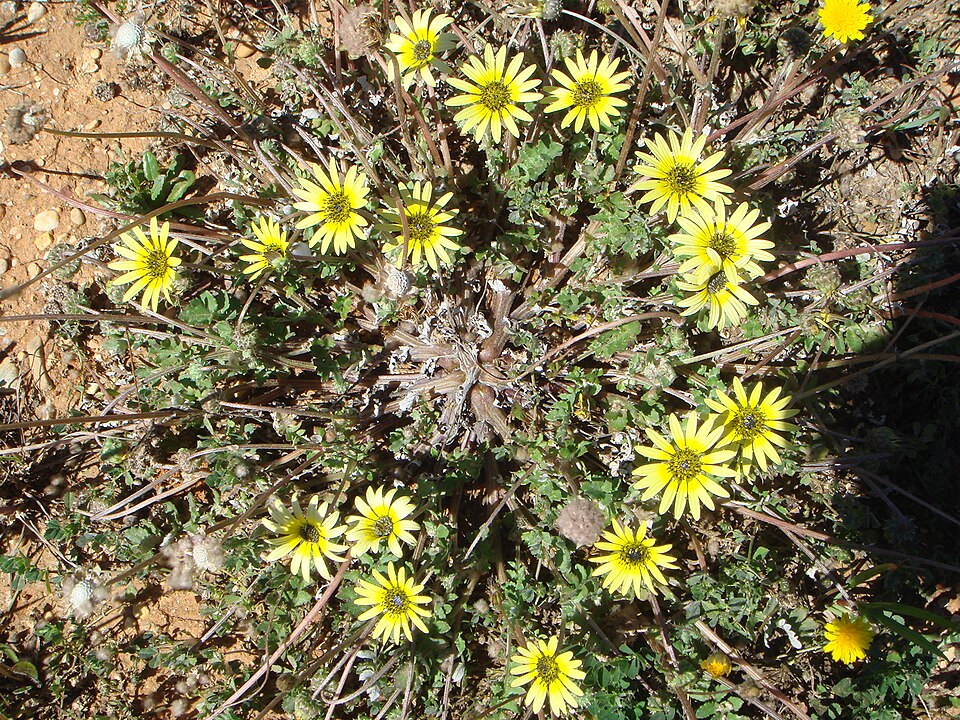
Arctotheca is a genus of low, mat-forming herbs in the daisy family Asteraceae, native to southern Africa and containing about five species. Plants form ground-hugging rosettes of lobed leaves that are dark green above and densely white-woolly beneath, spreading by runners or seed to cover bare ground. The leaves are 2-8 inches (5-20 cm) long, coarsely toothed or deeply cut. Solitary daisy-like flower heads 1.5-2 inches (4-5 cm) across rise on short stalks, with yellow ray florets, sometimes paler or cream, around a dark purple-brown central disk. A. calendula, the capeweed, is an annual or short-lived species that has spread as a weed across Australia, California, and other mild regions, where it can blanket pastures and disturbed ground. A. prostrata and A. populifolia are spreading perennials used as drought-tolerant groundcover and dune-binders. The genus grows in sandy coastal ground, grassland, roadsides, and disturbed sites, tolerating heat, salt, wind, and poor soil. Flowering is heaviest in spring, and the heads close at night and in dull weather. Where it naturalizes, the dense mat and heavy seeding let it crowd out smaller plants, and capeweed can build up nitrate to levels harmful to grazing stock.
Native Range
Native to southern Africa, mainly South Africa, in sandy coastal ground, grassland, and disturbed open sites. Plants grow in sunny, well-drained, often poor or sandy soils.Suggested Uses
Arctotheca is grown as a fast, drought-tolerant groundcover on sunny banks, sandy sites, and coastal dunes, where the perennial species bind loose soil. The spring daisies draw bees and other insects. Its salt and wind tolerance suit it to seaside and dry-climate plantings, though its weedy spread limits use near farmland and natural areas.How to Identify
Appearance
Size & Dimensions
Height4" - 1'
Width/Spread1' - 3'
Bloom Information
Flowering is heaviest in spring, from late winter into early summer, with scattered heads at other times in mild climates. Each head opens in sunshine and closes at night and in dull weather over several days. Annual species set abundant wind- and animal-spread seed soon after flowering.
Detailed Descriptions
Flower Description
yellow with dark centerFoliage Description
green above, white-woolly beneathGrowing Conditions
Sun Requirements
Requires 6-12 hours of direct sunlight daily
• Full Sun: 6+ hours of direct sunlight
• Partial Shade: 3-6 hours of direct sunlight
• Full Shade: Less than 3 hours of direct sunlight
Water & Climate
Water Needs
Drought Tolerance
Drought tolerant when established
Care & Maintenance
Care Guide
Plants grow in full sun and sharply drained, sandy or poor soil, tolerating heat, salt, wind, and drought once established, at a pH near 6.0 to 7.5. The genus dislikes heavy, wet, or shaded ground, where it rots or grows thin and leggy. The perennial groundcover species are hardy in mild, frost-free to lightly frosted climates, roughly USDA zones 9 to 11, while A. calendula grows as a fast annual that dies after seeding. Propagation is by runners and division for the perennials and by seed for the annual species. Little water or feeding is needed, and overwatering causes soft, disease-prone growth. Because some species seed and spread aggressively, they are contained where they might escape into pasture or wild land.Pruning
Spreading mats are trimmed or mown to control their spread and remove faded growth. Cutting back after the main spring flush tidies the planting and can prompt a second round of bloom. Removing seed heads before they ripen limits the self-sowing that makes annual species weedy.Container Growing
Suitable for container growing
Minimum container size: 2 gallons
